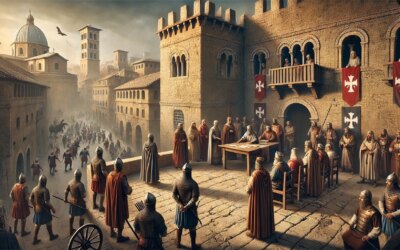

In the tumultuous landscape of 8th-century Italy, the balance of power was in constant flux, with the Byzantine Empire’s influence waning and the nascent Papal States struggling for autonomy against the aggressive expansion of the Lombard Kingdom. At the heart of this volatile period stood King Desiderius, who ascended to the Lombard throne in 757 AD. His reign marked a determined effort at Lombard Power Consolidation, a strategic move to restore the kingdom’s former glory and control over the Italian peninsula. Around 763 AD, Desiderius was actively pursuing policies to reassert Lombard dominance, challenging the authority of the Roman See and setting the stage for a dramatic confrontation that would eventually involve the rising power of the Franks. This era was characterized by intricate political maneuvering, military campaigns, and diplomatic overtures, all centered on the Lombard ambition to solidify its presence and diminish rival claims to Italian territory, ultimately shaping the destiny of early medieval Italy.
Desiderius’s Rise to Power and Ambitions
King Desiderius, the last ruler of the independent Lombard Kingdom, began his reign in 757 AD. His predecessor, Aistulf, had been defeated by Pepin the Short, leading to the establishment of the Papal States through the Donation of Pepin. Desiderius initially sought to maintain a more conciliatory stance towards the Franks and the Papacy, but this soon shifted. His primary ambition was to restore the Lombard Kingdom’s territorial integrity and political influence, which had been significantly curtailed by previous Frankish interventions. This meant reasserting control over the various Lombard duchies, particularly Spoleto and Benevento, and expanding influence into territories claimed by the Papacy or still under nominal Byzantine authority. Desiderius’s cunning diplomacy and military prowess were key to his strategy.
Lombard Strategies for Dominance
Desiderius pursued a multifaceted strategy for Lombard Power Consolidation. This involved:
- Military Campaigns: Launching expeditions against rebellious Lombard dukes and encroaching upon papal territories.
- Dynastic Marriages: Arranging alliances, notably the marriage of his daughter Desiderata (or Hermengard) to Charlemagne, though this alliance was short-lived.
- Intervention in Papal Politics: Attempting to influence papal elections and installing pro-Lombard candidates, often through forceful means.
These actions, particularly those targeting the Papacy, eventually led to renewed calls for Frankish intervention.
The Papacy Under Siege: Pope Paul I and Stephen III
The aggressive policies of King Desiderius placed immense pressure on the Papacy. Pope Paul I, who reigned from 757 to 767 AD, found himself constantly negotiating with Desiderius to protect the newly formed Papal States. Desiderius frequently reclaimed cities and territories that the Franks had supposedly ‘donated’ to the Pope. The Lombard king’s ability to manipulate local politics and exploit internal divisions within Rome often left the popes in a precarious position. After Paul I’s death, the succession struggle for the papacy further complicated matters, with various factions vying for control, often seeking Lombard support or opposing it fiercely.
Lombard Influence in Rome
The period around 763 AD saw Desiderius’s influence growing even within Rome itself. He supported certain anti-Frankish factions and sought to undermine papal independence. For example, during the chaotic papal elections after Paul I, Desiderius played a significant role, attempting to install his own candidate. Pope Stephen III (768-772 AD) struggled to maintain autonomy amidst fierce internal Roman rivalries and constant Lombard threats. This external pressure and internal strife highlighted the urgent need for a stronger protector, which ultimately paved the way for Charlemagne’s decisive intervention.
Shifting Alliances and the Frankish Shadow
Desiderius’s efforts at Lombard Power Consolidation were conducted under the ever-present shadow of the powerful Frankish Kingdom. While Desiderius initially tried to forge alliances, particularly through the marriage of his daughter to Charlemagne, this diplomatic strategy proved fragile. Charlemagne’s subsequent repudiation of Desiderata signaled a cooling of relations and a renewed threat to Lombard independence. The Papacy, repeatedly menaced by Desiderius’s territorial ambitions and interventions in Roman politics, consistently appealed to the Franks for protection, invoking the legacy of Pepin’s Donation.
Charlemagne’s Impending Intervention
By the 770s, Desiderius’s aggressive posture, including seizing papal cities and threatening Rome itself, compelled Pope Hadrian I to appeal directly to Charlemagne. The Frankish king, seeing an opportunity to consolidate his own influence in Italy and fulfill his role as protector of the Church, would eventually launch a full-scale invasion of the Lombard Kingdom. This intervention, culminating in the siege of Pavia and the eventual fall of Desiderius in 774 AD, marked the definitive end of the independent Lombard Kingdom and profoundly reshaped the political map of Italy, laying crucial groundwork for the future Holy Roman Empire.
Frequently Asked Questions
Who was King Desiderius and when did he rule?
King Desiderius was the last ruler of the independent Lombard Kingdom in Italy. He reigned from 757 AD until his defeat by Charlemagne in 774 AD. His reign was characterized by efforts at Lombard Power Consolidation.
What was the ‘Donation of Pepin’ and how did it affect Desiderius?
The Donation of Pepin (756 AD) was a grant of territory from the Frankish king Pepin the Short to the Papacy, forming the basis of the Papal States. Desiderius, upon becoming king, challenged these donations, seeking to reclaim or control these territories for the Lombard Kingdom, leading to conflict with the Popes and eventually the Franks.
How did Desiderius attempt to consolidate Lombard Power in Italy?
Desiderius employed a combination of military campaigns against rebellious Lombard dukes and papal territories, strategic dynastic marriages (like his daughter to Charlemagne), and interventions in papal elections to secure pro-Lombard popes, all aiming to strengthen Lombard control over the Italian peninsula.
What role did the Franks play in the conflict with Desiderius?
The Franks, under Pepin the Short and later Charlemagne, were the primary protectors of the Papacy. When Desiderius’s aggressive Lombard Power Consolidation threatened Rome and the Papal States, the Popes repeatedly appealed to the Franks, leading to two major Frankish interventions that ultimately resulted in the downfall of the Lombard Kingdom.
What was the ultimate outcome of Desiderius’s reign?
Desiderius’s aggressive policies to consolidate Lombard power ultimately backfired. His persistent threats to the Papacy led to Charlemagne’s invasion of Italy in 773-774 AD, which resulted in the siege of Pavia, Desiderius’s capture, and the end of the independent Lombard Kingdom. Charlemagne then crowned himself ‘King of the Lombards’.