In the late 6th century, Rome was a city besieged not only by political upheaval and the encroaching Lombard threat but also by the invisible, terrifying enemy of pestilence. The year 590 AD marked a particularly grim period, as a devastating plague swept through the city, claiming countless lives, including that of Pope Pelagius II. Amidst this profound crisis, a man of immense spiritual and administrative capability, Gregory, rose to the papal throne. His unwavering dedication and innovative leadership during this dark hour define what is remembered as Pope Gregory’s Plague Response. His actions not only provided solace and practical aid to a suffering populace but also solidified the role of the papacy as a central authority in the fragmented landscape of early medieval Italy, setting a precedent for papal influence for centuries to come.
The Desolation of Rome in 590 AD
By 590 AD, the Eternal City had long shed its imperial grandeur, yet it remained a symbolic heart for much of Christendom. However, it was also vulnerable, with its population greatly reduced and its infrastructure in decay after decades of Gothic Wars and Lombard incursions. The plague that arrived in this fragile state was a catastrophic blow. Its exact nature is debated by modern historians, but contemporary accounts describe a highly virulent and lethal disease, possibly a recurrence of the Justinianic Plague, characterized by fevers, swellings, and rapid death. The streets filled with the dying, and the living were consumed by fear and grief. Pope Pelagius II himself succumbed, leaving a desperate city without its spiritual shepherd and administrative head.
The lack of a strong Byzantine presence meant that the local Roman authorities struggled to cope. The traditional civic structures had long weakened, and the Church, with its network of charities and spiritual influence, was often the only institution capable of providing any semblance of order and aid. This period was one of profound anxiety, where the tangible threat of disease combined with the ever-present danger from the Lombard invaders, who frequently raided the Roman countryside, cutting off food supplies and further exacerbating the city’s plight.
Pope Gregory’s Spiritual and Pastoral Leadership
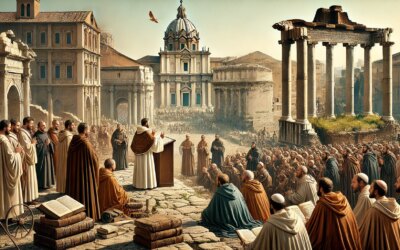
Upon the death of Pelagius II, the clergy and people of Rome unanimously elected Gregory, a former city prefect and papal envoy to Constantinople, who reluctantly accepted the weighty responsibility. His first and most enduring response to the plague was a call for profound spiritual awakening and communal repentance. He immediately organized a massive seven-fold litany procession through the city. This procession involved different segments of the populace – clergy, monks, nuns, children, and married men and women – each starting from a different church and converging at the Basilica of Santa Maria Maggiore.
The Seven-Fold Litany
- The Clergy: Starting from the Church of Saints Cosmas and Damian.
- Abbesses and their communities of Nuns: From the Church of Saints Marcellinus and Peter.
- Deacons and their attendants: From the Church of Saints Protus and Hyacinth.
- Abbots and their Monks: From the Church of Saint John the Baptist.
- Married Women: From the Church of Saint Stephen the Protomartyr.
- Widows and Married Men: From the Church of Saint Vitale.
- Children and the Poor: From the Church of Saints Gervasius and Protasius.
During this procession, Gregory exhorted the people to pray fervently, believing that divine intervention was their only hope. Legend states that during one such procession, as Gregory passed Hadrian’s Mausoleum, he saw a vision of the Archangel Michael sheathing his sword atop the structure, signaling the end of the plague. This event gave the mausoleum its modern name, Castel Sant’Angelo.
Rebuilding and Administering a City in Crisis
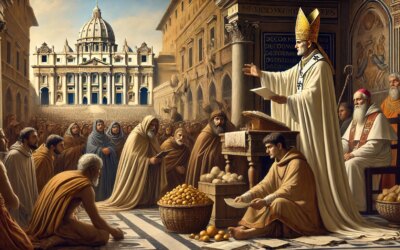
Beyond spiritual leadership, Pope Gregory I displayed immense practical skill in administering the afflicted city. He understood that faith alone was not enough; the people needed food, shelter, and order. He effectively managed the vast estates of the Roman Church, known as the patrimonia Petri, which were spread across Italy and beyond. He ensured that grain was shipped to Rome, providing much-needed sustenance to a population weakened by disease and disrupted agriculture. His efficient organization of food distribution often meant the difference between life and death for thousands of Romans.
Gregory’s Administrative Innovations
- Systematic Almsgiving: Regular distribution of food and aid to the poor and sick.
- Diplomatic Engagement: Negotiating with the Lombard invaders to protect Roman territories and populations, often filling a void left by the distant Byzantine emperor.
- Strengthening Church Governance: Reorganizing the Church’s administrative structures to be more responsive to social and economic crises.
Gregory’s actions during the plague and in the subsequent years transformed the papacy from primarily a spiritual office into a significant temporal power, capable of governing, defending, and provisioning the city of Rome. His legacy as ‘the Great’ is rooted not only in his theological writings and liturgical reforms but also in his steadfast leadership during this period of existential crisis, a leadership that truly saved Rome from collapse.
Frequently Asked Questions
What caused the ‘Plague of 590 AD’ in Rome?
The ‘Plague of 590 AD’ is generally believed to be a recurrence of the Justinianic Plague, a devastating pandemic of bubonic plague that first struck the Byzantine Empire in the mid-6th century. It caused high mortality rates across the Mediterranean.
How did Pope Gregory I become Pope during this crisis?
Gregory was elected Pope by the clergy and people of Rome after his predecessor, Pelagius II, died from the plague. Despite his initial reluctance and attempts to avoid the office, he was consecrated on September 3, 590 AD, at a time when Rome was at its most vulnerable.
What specific actions did Pope Gregory I take to combat the plague?
Pope Gregory I famously organized a massive seven-fold litany procession throughout Rome, urging communal prayer and repentance. He also provided practical leadership by managing the Church’s vast estates to ensure food distribution and aid for the suffering population, effectively governing the city in the absence of strong imperial authority.
What is the legend of the angel and Castel Sant’Angelo?
During one of Pope Gregory’s litany processions, a legend states that he saw a vision of the Archangel Michael atop Hadrian’s Mausoleum, sheathing his sword. This vision was interpreted as a sign that the plague would soon end, leading to the mausoleum being renamed Castel Sant’Angelo (Castle of the Holy Angel).
What was the long-term impact of Pope Gregory’s leadership during the plague?
Pope Gregory I’s decisive leadership during the plague not only saved many lives and stabilized Rome but also significantly enhanced the papacy’s temporal authority. His actions in governing, provisioning, and defending Rome established the Pope as the primary secular leader in central Italy, laying crucial groundwork for the future Papal States and the medieval papacy’s influence.