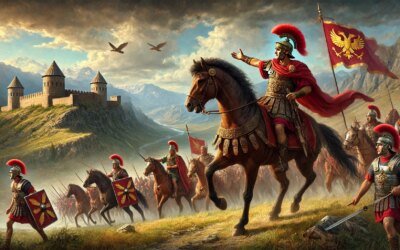

In the tumultuous climate of the Third Century Crisis, marked by constant barbarian incursions and internal strife, Emperor Aurelian undertook a decision of profound strategic significance: Aurelian’s Dacia withdrawal. This pragmatic yet painful relinquishment of the Transdanubian province, occurring roughly between 271 and 275 AD, marked a pivotal moment in Roman imperial policy. Unlike earlier periods of expansion, this act represented a conscious contraction, a recognition of the empire’s overextension and the unsustainable cost of defending a salient beyond the more defensible Danube frontier. It was a calculated move to consolidate resources, improve defensive capabilities, and stabilize a realm teetering on the brink of collapse, highlighting Aurelian’s reputation as a ‘Restitutor Orbis’ – Restorer of the World – even if it meant abandoning a territory that had been Roman for over 160 years since Trajan’s conquest.
The Unsustainable Burden of Dacia
Since its conquest by Emperor Trajan in the early 2nd century AD, Dacia had been a rich, but perpetually troublesome, Roman province. Its fertile lands and mineral wealth, particularly gold, provided significant resources to the empire. However, its geographic position, jutting out beyond the natural defensive line of the Danube River, made it exceptionally vulnerable. By the mid-3rd century, the Roman Empire was grappling with the profound instability of the Third Century Crisis, facing simultaneous threats from multiple directions. The Carpi, Goths, Vandals, and other Germanic tribes constantly harassed Dacia’s borders, requiring immense military presence and continuous campaigns. Maintaining legions and infrastructure so far north of the Danube had become an extraordinary drain on imperial resources, both in manpower and funds. The constant need for reinforcements and the high casualty rates made Dacia a seemingly bottomless pit of Roman blood and treasure, forcing a re-evaluation of its strategic value against its immense cost.
Barbarian Incursions and Imperial Instability
The decades leading up to Aurelian’s Dacia withdrawal were defined by relentless pressure from beyond the Danube. Successive emperors struggled to contain the barbarian onslaught, often diverting crucial legions from other threatened frontiers. This internal instability, with numerous usurpers and short-lived reigns, further exacerbated the issue, making it impossible to commit a consistent, long-term defense strategy for a peripheral province like Dacia. Aurelian, upon ascending to power, inherited an empire teetering on the brink, and recognized that maintaining every inch of territory, regardless of strategic viability, was a luxury Rome could no longer afford.
Aurelian’s Pragmatic Strategic Vision
Emperor Aurelian, often hailed as the ‘Restorer of the World’, was renowned for his military prowess and pragmatic approach to imperial governance. His decision regarding Dacia was not a sign of weakness, but a calculated move to strengthen the empire by consolidation. He understood that a shorter, more defensible frontier along the Danube would free up legions for other critical areas and reduce the overall military expenditure. The Danube River provided a natural barrier that was far easier to defend than the exposed plains of Transdanubia. Aurelian’s vision involved creating a more compact and resilient empire, capable of defending its vital core rather than overextending its reach into indefensible salients.
Re-establishing Rome’s Defensive Stance
The strategy behind Aurelian’s Dacia withdrawal was multifaceted. It aimed to:
- Consolidate Forces: Withdraw legions and auxiliary units from Dacia to reinforce other key frontiers and critical regions.
- Strengthen the Danube Line: Focus defensive efforts and build new fortifications along the more natural and defensible Danube River.
- Relocate Population: Ensure the safety of Roman citizens and Daco-Roman populations by relocating them to new territories south of the Danube.
- Reduce Economic Strain: Cut the immense costs associated with defending and maintaining a distant and embattled province.
This forward-thinking policy, though unpopular with some traditionalists, reflected Aurelian’s understanding of the changing geopolitical landscape and Rome’s dwindling resources.
The Evacuation and the New Dacian Provinces
The process of Aurelian’s Dacia withdrawal was an organized and deliberate effort, not a chaotic retreat. Between approximately 271 and 275 AD, Roman forces systematically evacuated the province. Roman citizens, soldiers, and, importantly, the local Daco-Roman population who wished to remain under Roman rule, were transported south across the Danube. To preserve the name and honor of Dacia, Aurelian established two new provinces within the existing Roman territory south of the Danube: Dacia Ripensis (along the river banks, focused on military defense) and Dacia Mediterranea (further inland, with Serdica as its capital, focused on civilian administration). These new provinces were carved out of Moesia Superior and Thracia, providing new homes and lands for the relocated population.
Long-Term Repercussions and Legacy
The abandonment of Dacia was a significant precedent, marking one of the first times Rome formally relinquished a large, established province, rather than losing it through direct conquest. While it might have been perceived as a loss of prestige, it was a practical decision that allowed Aurelian to secure the empire’s immediate future. The new Danube frontier proved more manageable, and the consolidation allowed Rome to regroup. However, the vacuum created in Transdanubia was quickly filled by barbarian tribes, who would continue to exert pressure on the Roman borders for centuries to come. The memory of Roman Dacia, though physically abandoned, persisted in Roman consciousness, embodying both the glory of Trajan’s conquests and the harsh realities of a struggling empire.
Frequently Asked Questions
What prompted Emperor Aurelian’s Dacia withdrawal?
Emperor Aurelian’s Dacia withdrawal was primarily prompted by the enormous military and economic burden of maintaining the province, which was exposed beyond the defensible Danube River. Constant barbarian incursions, especially from Goths and Carpi, drained imperial resources and manpower during the tumultuous Third Century Crisis.
How was the Dacia withdrawal executed by Aurelian’s administration?
The withdrawal was an organized process, not a chaotic abandonment. Roman legions, auxiliary units, and citizens who wished to remain under Roman rule were systematically evacuated across the Danube River to new territories designated by Aurelian.
What new Roman provinces were created as a result of the Dacia withdrawal?
To maintain the name and Roman identity associated with Dacia, Aurelian established two new provinces south of the Danube, carved out of existing Roman territory: Dacia Ripensis and Dacia Mediterranea. These served as new homes for the relocated populations.
Did Aurelian’s Dacia withdrawal signify a permanent shift in Roman imperial strategy?
Yes, in many ways it did. While it was a practical response to an immediate crisis, it also set a precedent for Rome’s future strategic contractions, moving away from constant expansion towards a more defensive consolidation of its core territories, especially along natural frontiers like the Danube.
What was the long-term impact of the Dacia withdrawal on the Roman Empire’s frontiers?
The long-term impact was a more consolidated and defensible Danube frontier, allowing Rome to reallocate resources and strengthen its defenses. However, the abandoned territory became a power vacuum, frequently used by barbarian tribes as a staging ground for further incursions into the Roman Empire.