
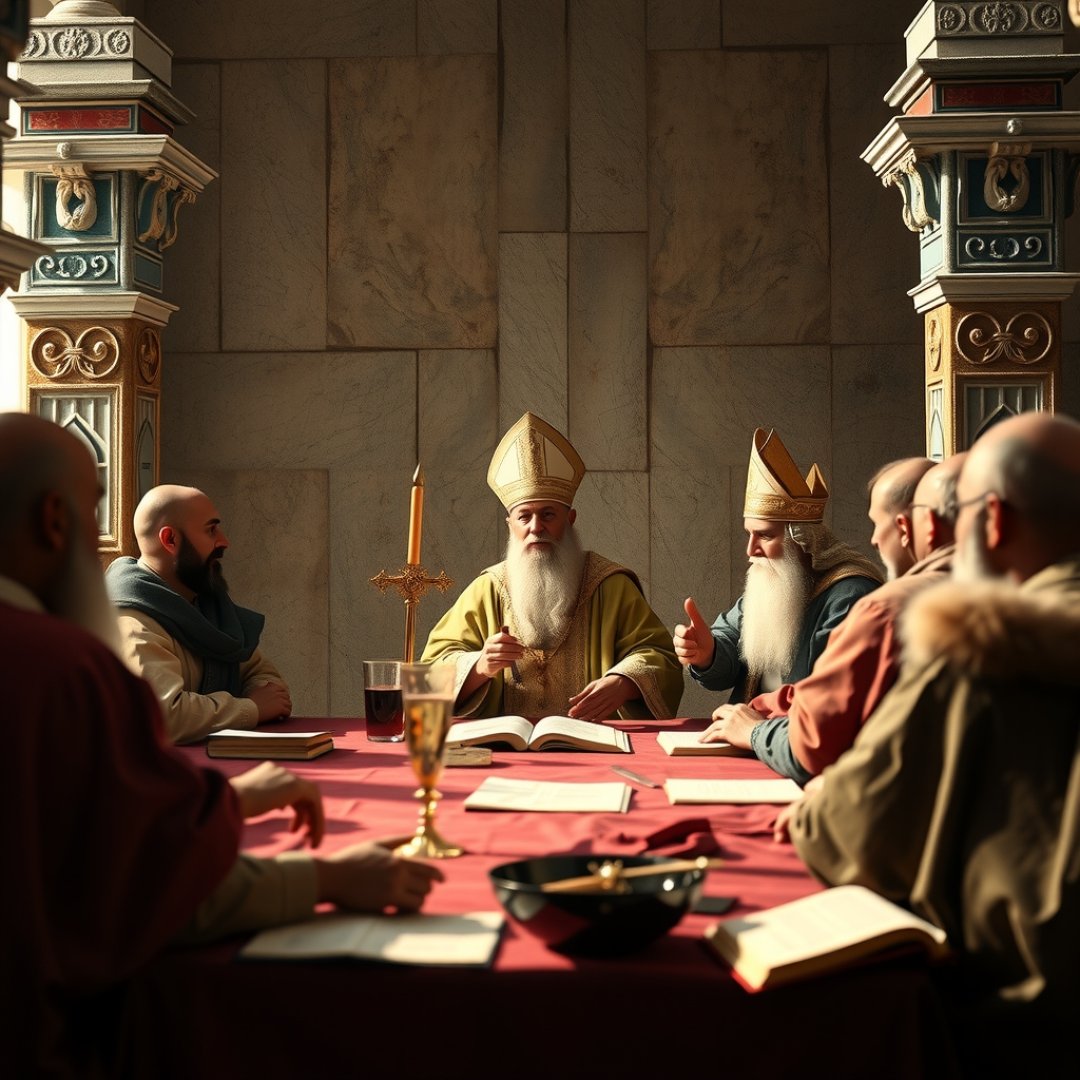
In the tumultuous landscape of the early Middle Ages, where theological disputes often intertwined with imperial politics, a critical gathering took place in Rome. This assembly, known as the Roman Synod 680 AD, was convened by Pope Agatho, a venerable and politically astute pontiff who understood the pressing need to address the lingering Monothelete controversy. The synod represented a crucial moment for the Western Church, consolidating its doctrinal position before confronting the Byzantine East. It was not merely a local meeting but a meticulously orchestrated prelude to the Sixth Ecumenical Council, designed to present a unified front against a heresy that threatened to destabilize the very foundations of Christian theology regarding the nature of Christ. Pope Agatho’s firm leadership during this period was instrumental in reasserting papal authority and clarifying orthodox Christology, laying the groundwork for a definitive resolution that would have lasting implications for both East and West.
The Shadow of Monothelitism: A Lingering Heresy
Following the major Christological controversies of the 5th and 6th centuries, the early 7th century saw the rise of Monothelitism, a doctrine proposing that Christ possessed two natures (divine and human) but only one divine will or energy. This theological compromise was primarily an imperial initiative, championed by Emperor Heraclius and Patriarch Sergius I of Constantinople, in an attempt to reconcile the Monophysite Christians (who believed Christ had a single, divine nature) with the Chalcedonian orthodox position (two natures in one person). While seemingly a subtle distinction, it had profound implications for Christian doctrine, as it was perceived by many in the West as undermining the fullness of Christ’s humanity. Previous attempts to resolve this, notably at the Lateran Council of 649 AD under Pope Martin I, had resulted in severe imperial persecution and did not fully extinguish the heresy, leaving the theological landscape fractured and contentious, particularly between Rome and Constantinople.
Pope Agatho’s Convocation: Unifying the Western Church
Upon his election in 678 AD, Pope Agatho immediately recognized the urgency of definitively addressing Monothelitism. Rather than acting unilaterally, he embarked on a remarkable diplomatic and ecclesiastical campaign to unify the Western Church’s stance. Agatho called for a series of regional synods across Italy and beyond, including assemblies in Lombard and Frankish territories, ensuring that the papal position would be representative of the entire Western episcopate. These preparatory meetings culminated in the great Roman Synod 680 AD, held in the Basilica of St. Peter. Over 125 bishops, including representatives from various Western sees, gathered to meticulously discuss and formulate a clear Christological definition. The synod unequivocally condemned Monothelitism as heretical, reaffirming the orthodox teaching of two wills and two energies in Christ, corresponding to his two distinct natures. The pronouncements of this synod were compiled into a lengthy, eloquent letter known as the Tomus ad Imperatores, addressed to Emperor Constantine IV, articulating the unified Western doctrine.
The Road to Constantinople III: Western Doctrine Confirmed
The Tomus ad Imperatores, forged during the Roman Synod 680 AD, proved to be a document of immense historical and theological weight. Pope Agatho dispatched legates to Constantinople, bearing this crucial text, to present the Western Church’s unified position to Emperor Constantine IV, who had called for an Ecumenical Council to finally settle the Monothelite controversy. The Sixth Ecumenical Council, also known as Constantinople III, commenced in late 680 AD and concluded in 681 AD. The carefully articulated doctrine of the Roman Synod formed the bedrock of the council’s deliberations. Despite Pope Agatho’s death in January 681 AD, before the council officially concluded, his monumental efforts and the synod’s declaration were upheld. The council ultimately condemned Monothelitism and Monotheletism, affirming the existence of two natural wills and two natural energies in Jesus Christ, without division, change, separation, or confusion. This resolution, heavily influenced by Agatho’s synod, brought an end to decades of theological strife and firmly re-established orthodox Christology, significantly bolstering papal authority in the process.
Frequently Asked Questions
What was Monothelitism?
Monothelitism was a Christian doctrine, primarily promoted by Byzantine emperors in the 7th century, which posited that Jesus Christ had two natures (divine and human) but only one divine will or energy. This was an attempt to reconcile theological factions but was condemned by the Orthodox Church as undermining Christ’s full humanity.
Who was Pope Agatho?
Pope Agatho reigned from 678 to 681 AD. He was an influential and diplomatic pontiff known for his strong stand against Monothelitism and his crucial role in convening the Roman Synod of 680 AD, which laid the doctrinal groundwork for the Sixth Ecumenical Council (Constantinople III).
Why was the Roman Synod of 680 AD convened?
The Roman Synod of 680 AD was convened by Pope Agatho to consolidate and articulate the unified Western Church’s orthodox position against the Monothelite heresy. It served as a preparatory council, ensuring that the Western delegation to the upcoming Sixth Ecumenical Council in Constantinople would present a clear and cohesive theological front.
What was the “Tomus ad Imperatores”?
The “Tomus ad Imperatores” was a lengthy letter drafted by the Roman Synod of 680 AD and sent by Pope Agatho to Emperor Constantine IV. It meticulously detailed the Western Church’s orthodox Christology, affirming two wills and two energies in Christ, and served as a foundational document for the deliberations of the Sixth Ecumenical Council.
What was the outcome of the Sixth Ecumenical Council (Constantinople III)?
The Sixth Ecumenical Council, heavily influenced by the Roman Synod of 680 AD, definitively condemned Monothelitism as a heresy. It affirmed the orthodox teaching that Christ possesses two natural wills and two natural energies, perfectly united in one person, reflecting his complete divine and human natures.
Related posts:
 Pope Gregory I’s Response to the Plague of 590 AD: A Leader in Crisis
 Pope Martin I and the Monothelete Controversy (649-655 AD): A Stand Against Imperial Heresy
 Narses’ Italian Administration (c. 555 AD): Rebuilding Byzantine Italy After the Gothic War
 The Battle of Faventia of 542 AD: Totila’s Resurgence in the Gothic War