
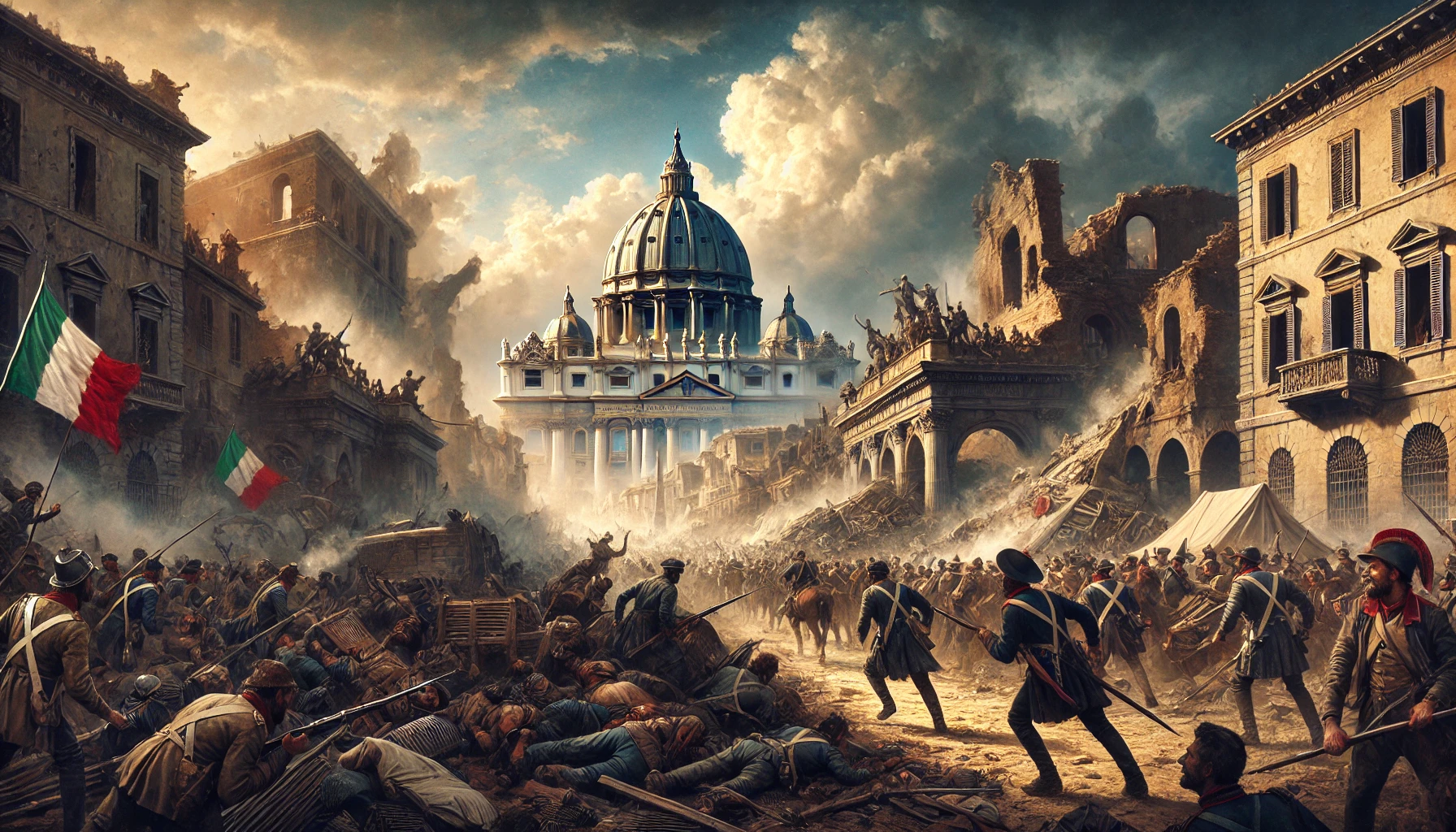
Introduction: Rome’s Brief Republic
In the revolutionary year of 1849, amid a wave of uprisings sweeping Europe, Rome briefly reemerged as a republic. Inspired by democratic ideals and national unity, the Roman Republic challenged centuries of papal rule. Its defense against overwhelming French forces, led by the legendary Giuseppe Garibaldi, became one of the most heroic—and tragic—chapters of the Italian Risorgimento.
The Birth of the Roman Republic
Following the assassination of Papal Minister Pellegrino Rossi and growing unrest, Pope Pius IX fled Rome in November 1848. In February 1849, a Constituent Assembly proclaimed the Roman Republic, abolishing the temporal power of the papacy. The new government promised religious freedom, universal suffrage, and social reforms—a bold vision rooted in the ideals of the French and American Revolutions.
Garibaldi’s Arrival
Giuseppe Garibaldi, already a renowned revolutionary fighter, arrived in Rome with a band of international volunteers. Charismatic and fiercely committed to the cause of liberty and Italian unification, Garibaldi quickly became the Republic’s military leader. Under his command, Roman forces prepared to defend their fragile democracy against external threats.
The French Intervention
Pope Pius IX, seeking to restore his authority, appealed to Catholic monarchies for help. In April 1849, French troops under General Nicolas Oudinot landed at Civitavecchia and marched on Rome. Initially repelled by Garibaldi’s forces in a daring defense at the Janiculum Hill, the French regrouped and launched a massive assault on the city by late June.
The Fierce Defense of Rome
Throughout June 1849, Garibaldi and his volunteers fought valiantly amid makeshift barricades and the ruins of ancient Rome. Battles raged near Porta San Pancrazio, Villa Pamphili, and along the Aurelian Walls. Despite being outnumbered and outgunned, the defenders inspired admiration for their determination and courage.
The Fall of the Republic
After a month of siege and brutal combat, the defenses collapsed. On July 3, 1849, the Roman Republic surrendered. Garibaldi, refusing to submit, led a daring retreat northward with a band of loyal fighters, beginning a legendary march across Italy. Many volunteers fell or were captured, but the dream of a free, unified Italy endured.
Legacy of 1849
The fall of the Roman Republic was a profound setback for Italian patriots, but it became a rallying cry for future generations. Garibaldi’s defense of Rome elevated him to the status of a national hero, and the ideals of 1849 would fuel the broader movement for Italian unification, ultimately achieved two decades later.
Conclusion: An Eternal Struggle
Though it lasted only a few months, the Roman Republic of 1849 left an indelible mark on history. It embodied the enduring human aspiration for freedom, justice, and national self-determination. Garibaldi’s stand amid the ruins of ancient Rome linked the city’s glorious past with the modern struggle for liberty—a story that continues to inspire to this day.