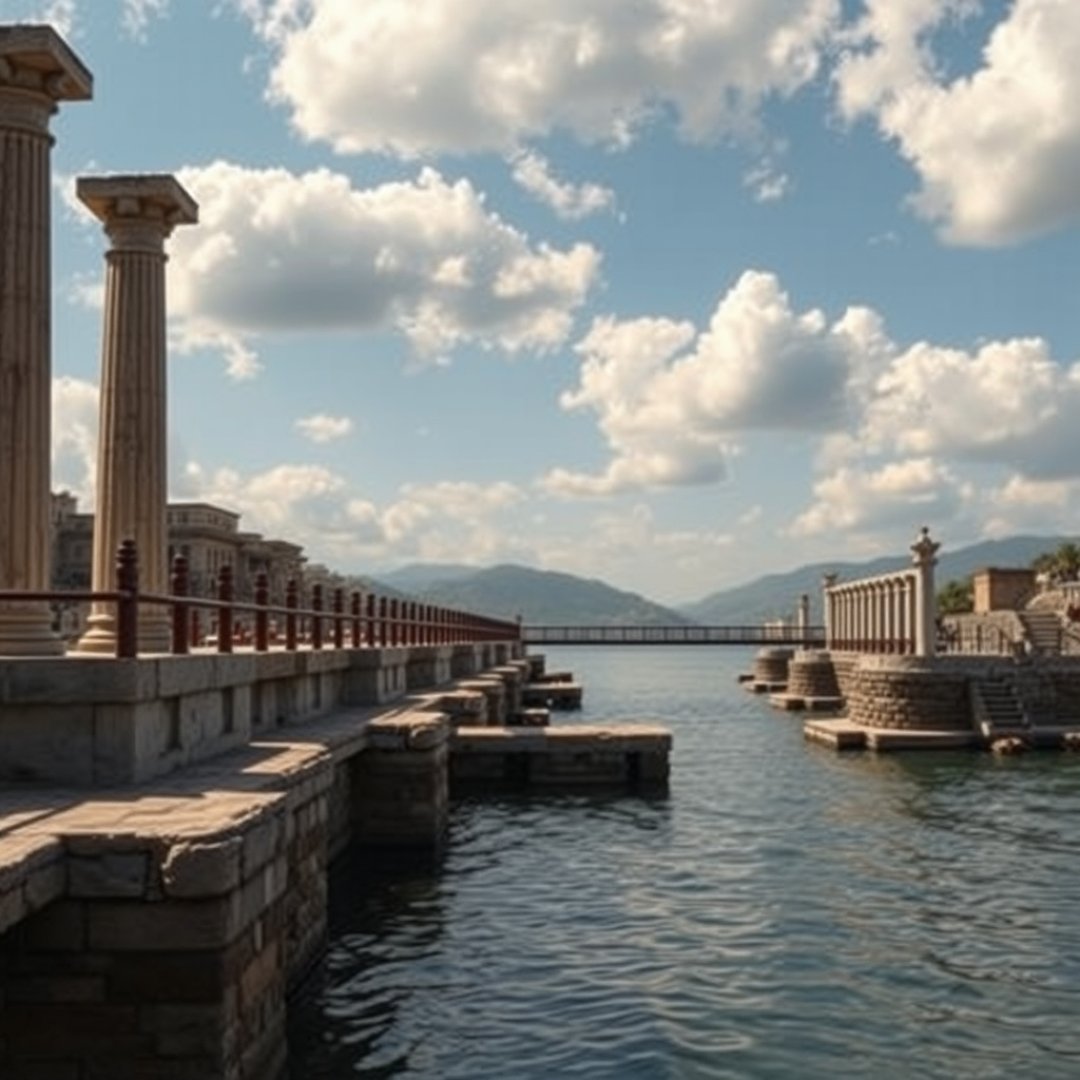
In AD 39, the Bay of Baiae, a scenic coastal retreat for Rome’s elite, became the stage for one of Emperor Caligula’s most outlandish and costly feats of engineering: the construction of the infamous Caligula’s Baiae Pontoon Bridge. This incredible undertaking involved linking Puteoli to Baiae, a distance of over three miles, using thousands of ships, purportedly for a single, extravagant equestrian procession. More than a mere engineering marvel, this bridge served as a stark demonstration of imperial power and Caligula’s unique brand of theatrical tyranny. Historians and contemporary accounts alike marvel at its sheer scale and the baffling motivations behind its creation, painting a vivid picture of an era defined by immense wealth, political instability, and the whims of an unpredictable emperor whose actions consistently pushed the boundaries of conventional Roman leadership and public expectation.
The Pretext and the Project: Why Build a Bridge Over Baiae?
Caligula’s decision to construct a pontoon bridge across the Bay of Baiae was steeped in rumor and imperial eccentricity. According to the historian Suetonius, one popular account suggests the emperor sought to refute an astrologer’s prophecy that he had ‘no more chance of becoming emperor than of riding a horse across the Bay of Baiae.’ By staging this elaborate event, Caligula could publicly mock the prophecy and assert his absolute power, demonstrating that he could achieve the seemingly impossible. Other interpretations suggest he wished to emulate the Persian King Xerxes, who famously bridged the Hellespont, thereby asserting Rome’s — and his own — dominance over even the natural world and the sea god Neptune. Regardless of the precise motivation, the project was undoubtedly a deliberate, grandiose gesture intended to awe and intimidate both his subjects and his rivals.
- Defiance of Prophecy: A direct challenge to an astrological prediction.
- Imperial Emulation: A desire to surpass the legendary feats of Eastern monarchs like Xerxes.
- Display of Power: An undeniable demonstration of the emperor’s ability to command vast resources and human labor.
An Engineering Marvel and Folly: Constructing the Pontoon Pathway
The construction of the Baiae Pontoon Bridge was an unprecedented logistical challenge. Roman sources indicate that thousands of ships, likely requisitioned from the imperial fleet and merchant vessels, were used to form the bridge. These ships were anchored side-by-side, stretching approximately three Roman miles (about 4.8 kilometers or 3 miles) from the bustling port of Puteoli to the resort town of Baiae. Planks and soil were then laid over the ships to create a solid roadway. This massive undertaking required immense coordination, vast quantities of materials, and an army of laborers and sailors. The sheer speed of its construction, reportedly completed within days, speaks volumes about the efficiency of Roman organization, even when applied to an emperor’s fleeting whim. It was a testament to Roman engineering prowess, even if the purpose was purely theatrical.
The Logistics of the Grand Design
The scale of the bridge necessitated:
- Vast Naval Resources: Drawing heavily from both military and commercial shipping.
- Extensive Labor Force: Thousands of workers for assembly and preparation.
- Material Procurement: Obtaining timber for planking and soil for the surface.
- Rapid Execution: A testament to Roman efficiency in marshaling resources for imperial directives.
The Grand Spectacle and Its Aftermath: Caligula’s Triumph
The culmination of this colossal project was Caligula’s magnificent procession. Dressed in a dazzling gold cloak, adorned with oak leaves, and carrying a shield from the heroes of the Trojan War, he rode his favorite warhorse across the newly formed bridge. The spectacle lasted two days. On the first day, he rode across on horseback; on the second, he returned in a chariot, preceded by lavish sacrifices and followed by his entire army. The event was accompanied by feasting, revelry, and even a mock sea battle. However, the bridge’s utility was as brief as its construction was swift. Shortly after the extravagant celebrations concluded, the ships were detached, and the roadway was dismantled, their component parts returned to their original duties. The Baiae Pontoon Bridge thus remains a singular, iconic example of Roman imperial excess and Caligula’s unbridled, theatrical reign.
The Theatrical Display
- Day One: Caligula, regally attired, rides across on horseback, emphasizing personal triumph.
- Day Two: A grand chariot procession, complete with sacrifices and a military escort, further cementing his imperial authority.
- Swift Disassembly: The bridge’s ephemeral nature underscores its purely symbolic purpose.
Frequently Asked Questions
What was Caligula’s Baiae Pontoon Bridge?
It was a massive temporary bridge built by Emperor Caligula in AD 39 across the Bay of Baiae, linking the towns of Puteoli and Baiae, primarily for a grand, theatrical procession.
What was the main purpose of the Caligula’s Baiae Pontoon Bridge?
While historians debate specific motives, it is widely believed to have been a monumental display of imperial power and wealth, possibly to defy a prophecy, emulate King Xerxes, or simply to indulge Caligula’s flamboyant nature, demonstrating his absolute control.
How long was the Caligula’s Baiae Pontoon Bridge?
The bridge stretched approximately three Roman miles (about 4.8 kilometers or 3 miles) across the Bay of Baiae, requiring thousands of ships for its foundation.
What happened to the bridge after Caligula’s procession?
The bridge was dismantled shortly after the two-day spectacle, with the ships used in its construction being returned to service. Its existence was purely for the emperor’s dramatic display, not for practical transportation.