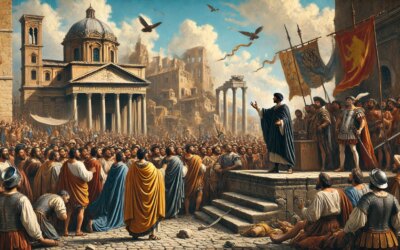

In the tumultuous year of 1267, the political landscape of Italy was irrevocably shaped by the ascent of Charles of Anjou, whose strategic maneuvers led him to wield significant influence as Charles Anjou Rome Senator. Having been crowned King of Sicily in 1266 by Pope Clement IV, Charles wasted no time in extending his authority northwards, positioning himself as a dominant force not just in the southern peninsula but also within the very heart of the Eternal City. This period marked a crucial juncture where the lingering imperial ambitions of the Hohenstaufens clashed with the burgeoning power of a new, Capetian-backed monarch, all under the watchful, often manipulative, eye of the Papacy. Rome, a city perpetually caught between secular and ecclesiastical aspirations, found itself under the firm, if temporary, grip of a foreign prince whose ambitions promised both order and potential subjugation. Charles’s senatorial rule represented a complex interplay of papal backing, military might, and the persistent desire of various factions within Rome to secure patronage and protection in an age defined by conflict and shifting loyalties, profoundly impacting the city’s future trajectory and its intricate relationship with the wider European powers.
The Anjou Ascendancy and Papal Alliance
Charles of Anjou, the ambitious younger brother of King Louis IX of France, rose to prominence in Italian politics through a strategic alliance with the Papacy. The Popes, particularly Urban IV and his successor Clement IV, were desperate to eradicate the long-standing Hohenstaufen threat to their temporal power in Italy. This ongoing struggle had pitted the Holy Roman Emperors against the papacy for centuries, culminating in the excommunication of Frederick II and his heirs. To counter the Hohenstaufen presence, the Pope invited Charles to claim the Kingdom of Sicily from Manfred, the illegitimate son of Frederick II.
This invitation led to the decisive Battle of Benevento in 1266, where Charles’s French and Provençal forces decisively defeated and killed Manfred. With this victory, Charles was crowned King of Sicily by Pope Clement IV, solidifying his control over Southern Italy and providing him with a formidable base from which to project power throughout the peninsula. Papal support was not merely spiritual; it included financial and logistical aid, establishing Charles as the foremost Guelph (pro-papal) champion and granting him significant leverage in Central Italian affairs, including within Rome itself.
Charles as Senator: Authority in the Eternal City
The office of Roman Senator in the 13th century was far from the republican institution of old; it had evolved into a powerful civil and often military magistracy, frequently held by powerful nobles or even foreign rulers. Charles of Anjou was first elected Senator in 1265, even before his decisive victory at Benevento, and his term was subsequently extended. This position granted him executive authority over Rome, enabling him to oversee its administration, maintain order, and manage its defenses.
His control over Rome was a crucial strategic asset. It provided a direct link between his southern kingdom and the Papal States, allowing for easier movement of troops and resources. More importantly, it endowed Charles with immense prestige and a legitimate claim to influence within the heart of Christendom. His senatorial rule also served to curb the incessant feuding of powerful Roman noble families, such as the Orsini and Colonna, bringing a temporary, if unwelcome, external authority to the city’s tumultuous politics. For the Papacy, Charles’s presence as Senator was a calculated move to secure Rome against lingering Ghibelline (pro-imperial) sympathies, even as they began to harbor concerns about his burgeoning power.
Roman Factions and Hohenstaufen Resistance
Despite Charles of Anjou’s firm grip on Rome as Senator, the city and surrounding regions remained a volatile mix of political loyalties. Rome itself was a traditional battleground for Guelph and Ghibelline factions, mirroring the broader Italian conflict. While the Papacy backed Charles, there were still pockets of Ghibelline sentiment, particularly among certain Roman aristocratic families and in parts of Tuscany, which viewed the Angevin presence with suspicion or outright hostility. This underlying tension provided fertile ground for any resurgence of Hohenstaufen claims.
In 1267, the young Conradin, the last legitimate male heir of the Hohenstaufen dynasty, began preparing his audacious invasion of Italy from Germany. His goal was to reclaim his family’s imperial inheritance and challenge Charles’s newly established authority. Charles’s position as Senator of Rome was therefore critical for the Papacy. It ensured that Conradin would not easily find a receptive base in Rome and that a strong, pro-papal power was poised to counter any northern advance. The year 1267 saw intensive diplomatic and military preparations on both sides, setting the stage for the dramatic confrontation that would unfold in the following year.
The Legacy of Angevin Power in Rome
While Charles of Anjou’s direct senatorial rule in Rome was relatively short-lived – he was eventually pressured by later Popes, particularly Nicholas III, to relinquish the office in 1278 due to concerns about his overwhelming power – his period of influence fundamentally altered the political landscape of Italy. His actions marked a definitive shift away from the direct imperial claims of the Hohenstaufens in Italy and solidified the Papacy’s role as a major temporal power broker, even as it sometimes struggled to control the very forces it had unleashed.
The Angevin presence in Rome and Southern Italy set precedents for future foreign involvement in Italian politics, laying foundations for the complex web of alliances and conflicts that would characterize the peninsula for centuries. Charles’s rule showcased the persistent struggle for control over Rome and Italy, moving beyond purely imperial-papal conflicts towards a more intricate interplay of emerging national powers, paving the way for further dynastic ambitions and a new era in the history of the Eternal City.
Frequently Asked Questions
Who was Charles of Anjou?
Charles of Anjou was the younger brother of King Louis IX of France, who became King of Sicily in 1266 with strong papal backing. He played a pivotal role in Italian politics during the mid-13th century, aiming to expand his dynastic influence and establish a new power block in the Mediterranean.
What was the role of a Roman Senator in 1267?
In 1267, the Roman Senator was the chief magistrate of the city, holding executive, judicial, and often military authority. This position was frequently granted to powerful non-Roman nobles or foreign rulers, affording them significant control over Rome’s administration, defense, and political stability amidst the ongoing power struggles between noble families and the Papacy.
How did Pope Clement IV influence Charles of Anjou’s power?
Pope Clement IV was instrumental in inviting Charles of Anjou to Italy and supporting his claim to the Kingdom of Sicily. The Papacy saw Charles as a vital tool to eradicate the Hohenstaufen threat and secure papal dominance in central Italy. By endorsing Charles, Clement IV not only legitimized his rule but also reinforced his political and military authority, including his senatorial position in Rome.
What was the significance of Charles’s rule in Rome for the Hohenstaufens?
Charles of Anjou’s strong presence as Senator in Rome directly countered the ambitions of the Hohenstaufen dynasty, particularly those of Conradin, the last legitimate heir. It denied Conradin a crucial base of support and a strategic entry point into central Italy for his planned invasion, significantly complicating his efforts to reclaim his imperial inheritance and ultimately contributing to the Hohenstaufen downfall.