
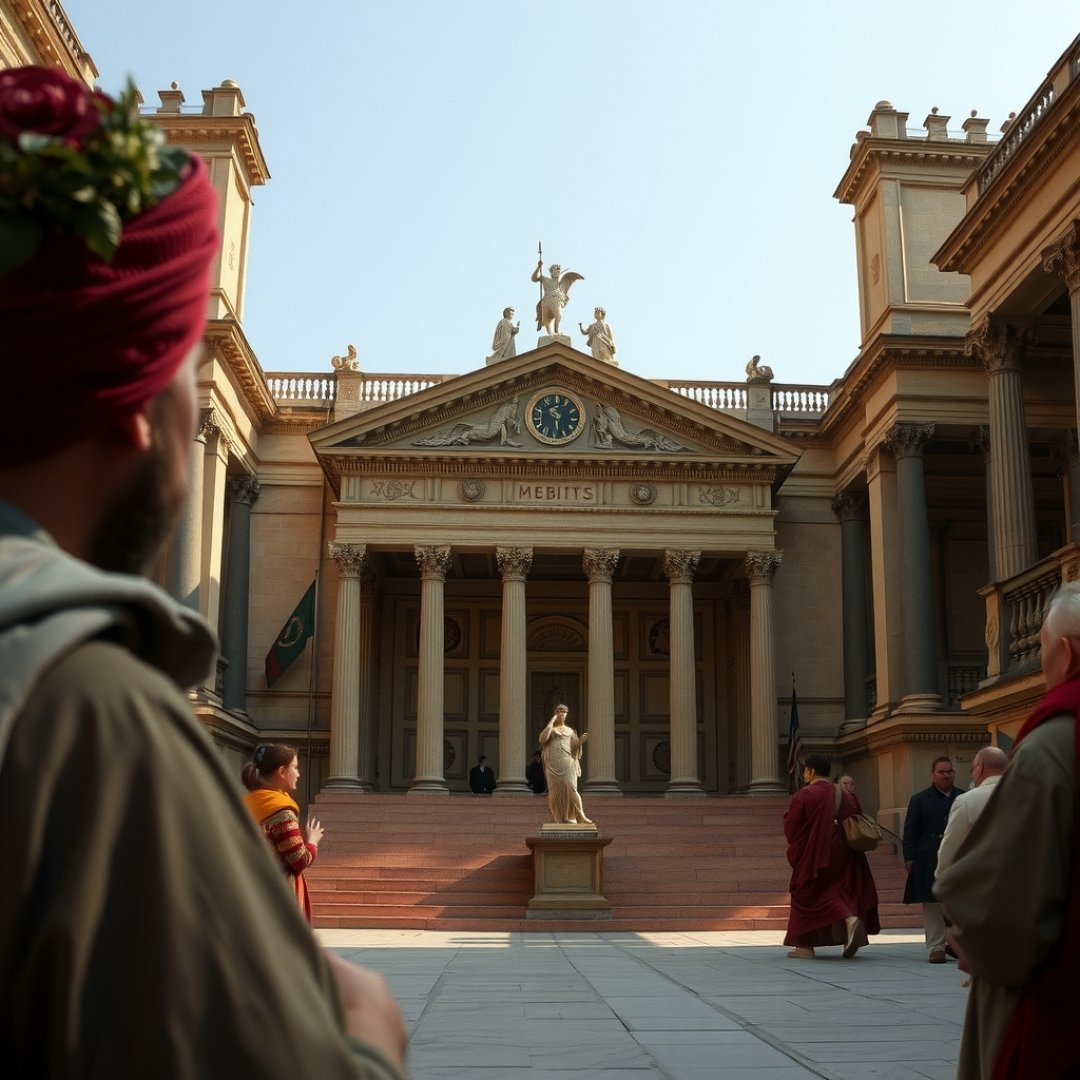
In the tumultuous landscape of the late fourth century Roman Empire, a seemingly simple bronze altar became the flashpoint for an ideological battle that underscored the profound shift occurring in Roman society. The Altar of Victory Controversy 384 pitted the champions of Rome’s ancient pagan traditions against the ascendant power of Christianity, revealing the deep fissures within the imperial elite and setting the stage for future religious policies. This episode, occurring specifically in AD 384, was not merely about a piece of venerable statuary; it was a struggle for the soul of the Roman state, a contest for public symbolism and imperial patronage. It brought forth eloquent arguments from both sides, most notably from the distinguished pagan senator Quintus Aurelius Symmachus and the formidable Christian Bishop of Milan, Ambrose, whose clash profoundly influenced the young emperor Valentinian II and ultimately dictated the course of religious freedom within the empire. The controversy illuminated the precarious balance between continuity and change, tradition and innovation, in a world grappling with its identity as it moved decisively away from its polytheistic past. Understanding this significant historical moment provides crucial insight into the complex religious and political dynamics of Late Antiquity, as the ancient pagan senatorial aristocracy made its final, impassioned plea for the recognition of their ancestral gods and practices.
The Symbol of Tradition: Rome’s Venerable Altar of Victory
For centuries, the Altar of Victory stood proudly in the Curia Julia, the Roman Senate House. This gilded statue of the goddess Victory, holding a wreath and poised over a globe, embodied the very essence of Rome’s martial prowess and its enduring success. Each senator, upon entering the chamber, would offer incense and make a brief prayer to the goddess, a ritual deeply ingrained in the fabric of Roman civic and religious life. The altar represented more than just a deity; it was a tangible link to Rome’s glorious past, a constant reminder of the divine favor that pagans believed had propelled the Republic and Empire to greatness. Its presence reinforced a continuity with ancestors and the traditional Roman values of piety (pietas) and duty (officium). By the late 4th century, however, the empire was increasingly Christianized, and the traditional pagan rituals associated with the altar became a source of contention for many Christian senators, who viewed it as a symbol of idolatry rather than venerable tradition.
Gratian’s Bold Move in 382 AD
The first decisive blow against the Altar of Victory came in AD 382, not from the East, but from the Western Emperor Gratian. Influenced by his close advisor, Bishop Ambrose of Milan, and increasingly devout in his own Christian faith, Gratian took the unprecedented step of ordering the altar’s removal from the Senate House. This act was part of a broader policy of disestablishing traditional pagan cults, including the confiscation of temple endowments and the removal of state subsidies for the Vestal Virgins and other priestly colleges. Gratian, the first emperor to refuse the title of Pontifex Maximus, effectively severed the imperial ties to Rome’s pagan past, a move that sent shockwaves through the conservative senatorial aristocracy who still largely adhered to the ancient polytheistic faith.
Symmachus’s Eloquent Appeal: The Voice of Ancient Rome
Following Gratian’s assassination in AD 383, his half-brother Valentinian II, a much younger and less experienced emperor, inherited the Western Empire. This presented a glimmer of hope for the beleaguered pagan faction. In AD 384, Quintus Aurelius Symmachus, a highly respected and influential senator, orator, and then Prefect of Rome, seized this opportunity. He spearheaded an embassy of senators to the imperial court in Milan to petition Valentinian II for the restoration of the Altar of Victory and the re-establishment of state support for pagan cults. Symmachus’s petition, known as the Relatio III, was a masterpiece of rhetoric and reasoned argument, eloquently defending Rome’s traditional religion.
Arguments for Restoration
- Ancestral Piety: Symmachus argued that Rome’s long history of success was inextricably linked to the worship of its traditional gods. He famously stated, “All things prosper as long as custom is preserved.”
- Gratitude and Continuity: He appealed to the idea that abandoning the gods who had guided Rome for a thousand years would be an act of ingratitude and a dangerous break with tradition. He presented the altar as a symbol of national identity.
- Unity and Tolerance: Symmachus advocated for a pluralistic approach to religion, suggesting that diverse paths could lead to understanding the divine. He noted that all men worship the same divinity, just under different names and rites. He sought not to suppress Christianity but to protect paganism.
- Famine and Omen: He subtly linked recent famines and misfortunes to the removal of the altar, implying divine displeasure and suggesting that restoring it could appease the gods and bring prosperity back to Rome.
Symmachus’s plea was not a call for pagan supremacy, but rather for the continuation of traditional practices alongside Christianity, demonstrating a desire for religious coexistence rather than conflict, even if on pagan terms. His arguments resonated deeply with many senators, both pagan and Christian, who valued the stability of long-held customs.
Ambrose’s Powerful Counter: Christian Imperial Authority
Symmachus’s eloquent petition was met with an equally powerful, and ultimately victorious, counter-argument from Bishop Ambrose of Milan. Ambrose was a formidable figure: a former provincial governor who had been unexpectedly elevated to the episcopacy, he possessed sharp legal acumen, profound theological conviction, and a commanding influence over the imperial court. Upon hearing of Symmachus’s embassy, Ambrose immediately sent two letters to Valentinian II, firmly advising against any compromise with paganism.
Ambrose’s Uncompromising Stance
Ambrose’s arguments were rooted in uncompromising Christian principles and a clear vision of imperial Christian duty:
- Christian Conscience: He warned Valentinian that restoring the altar would constitute an affront to God and a betrayal of his Christian faith. He asserted that a Christian emperor could not be complicit in idolatry.
- Divine Judgment: Ambrose threatened the emperor with divine wrath and the censure of the Church if he were to accede to Symmachus’s request. He argued that if the emperor allowed pagan rituals, he would lose the support of Christian citizens and risk eternal damnation.
- The Voice of Christian Senators: He claimed to speak for the Christian senators who, he asserted, would refuse to participate in any pagan ceremony if the altar were restored.
- Christian Superiority: Implicitly and explicitly, Ambrose presented Christianity as the superior and sole true religion, arguing that the empire’s successes now came from the Christian God, not pagan deities.
Ambrose’s intervention was successful. Valentinian II, young and susceptible to Ambrose’s authority and powerful rhetoric, rejected Symmachus’s petition. The Altar of Victory was not restored. This decision marked a profound symbolic victory for Christianity within the Roman Empire, further cementing its position as the dominant religion and signaling the irreversible decline of state-sanctioned paganism.
Lasting Implications of the 384 AD Controversy
The Altar of Victory Controversy 384 stands as a landmark event in the religious transformation of the Roman Empire. Its outcome solidified the policy initiated by Gratian and foreshadowed the more aggressive anti-pagan legislation that would follow under Emperor Theodosius I, such as the Edicts of Theodosius in 391 AD. The refusal to restore the altar was a clear demonstration that the imperial government, now firmly under Christian influence, would not countenance the public endorsement of pagan cults, even those as ancient and revered as the worship of Victory.
This episode also highlights the growing political power of bishops like Ambrose. His ability to directly influence imperial policy, even against the wishes of the Senate and prominent figures like Symmachus, indicated a significant shift in the balance of power. The Church was no longer merely a tolerated religion but a formidable political and moral force capable of shaping the destiny of the empire. For the pagan aristocracy, the defeat was deeply demoralizing, signaling the loss of their traditional spiritual bedrock and the irreversible decline of their way of life within the imperial system. The controversy is a vivid illustration of the clash of civilizations within the late Roman state, marking a definitive step towards the establishment of Christianity as the sole religion of the Roman world.
Frequently Asked Questions
What was the Altar of Victory?
The Altar of Victory was a gilded statue of the goddess Victory, situated in the Curia Julia (Senate House) in Rome. For centuries, Roman senators would offer incense and prayers to it as a traditional ritual, symbolizing Rome’s military success and the favor of its traditional gods.
Why was the Altar of Victory removed initially?
The altar was first removed in AD 382 by Emperor Gratian, a devout Christian. Influenced by Bishop Ambrose of Milan, Gratian sought to distance the imperial government from pagan practices, refusing to be Pontifex Maximus and disestablishing state support for pagan cults.
Who was Symmachus and what was his role in the controversy?
Quintus Aurelius Symmachus was a highly respected pagan senator and Prefect of Rome in AD 384. He led an embassy to Emperor Valentinian II, delivering his famous Relatio III, an eloquent petition arguing for the restoration of the Altar of Victory based on ancestral tradition, gratitude to the gods, and a plea for religious tolerance.
How did Bishop Ambrose of Milan counter Symmachus’s petition?
Bishop Ambrose sent strongly worded letters to Emperor Valentinian II, urging him not to restore the altar. Ambrose argued that a Christian emperor could not support idolatry, threatened divine displeasure, and asserted that restoring the altar would alienate Christian citizens.
What was the long-term significance of the Altar of Victory Controversy of 384 AD?
The controversy’s outcome solidified the shift towards Christian dominance in the Roman Empire. It demonstrated the growing political power of Christian bishops and signaled the irreversible decline of state-sanctioned paganism, paving the way for further anti-pagan legislation under emperors like Theodosius I.
Related posts:
 The Edict of Thessalonica: Christianity Becomes the Roman State Religion
 Helena in the Holy Land: The Empress, the Cross, and Christian Memory, 326 AD
 Theodosius’s Pagan Decree of 391 AD: The Official Suppression of Roman Polytheism
 The Laurentian Schism of 498 AD: A Struggle for the Papacy in Early Medieval Rome