
A Day of Disaster: July 18, 390 BCE
Among the darkest days in Rome’s early history stands the Battle of the Allia, fought on July 18, 390 BCE. This catastrophic engagement between the Roman army and a band of Gallic warriors led by the chieftain Brennus not only resulted in a crushing military defeat, but also opened the gates for one of the most traumatic events in Roman memory—the sack of Rome itself. The echoes of that day would shape Roman military doctrine, urban defense, and national psychology for centuries to come.
The Gauls March South
The Gauls, Celtic tribes hailing from the region of modern-day France, had long exerted pressure on northern Italy. By the late 5th and early 4th centuries BCE, they began pushing into Etruria, encountering little unified resistance. In 391 BCE, a Gallic force under Brennus besieged the Etruscan city of Clusium. When Clusium appealed to Rome for help, the Senate dispatched ambassadors—but these envoys acted provocatively, violating diplomatic norms by engaging in battle themselves.
In retaliation, the enraged Gauls turned their attention to Rome. Moving with shocking speed, they crossed the Tiber River, and within months, they were at Rome’s doorstep.
The Roman Response
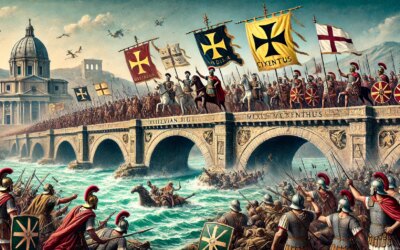
Rome, though a rising power in central Italy, was still a regional city-state with a modest standing army. Rushed and poorly coordinated, the Roman legions—composed largely of hastily gathered citizen-soldiers—advanced to intercept the Gallic army near the confluence of the Allia and Tiber Rivers, roughly 11 miles north of Rome. Lacking intelligence about the enemy’s size and strategy, the Romans chose a battlefield that would prove disastrous.
The Battle Unfolds
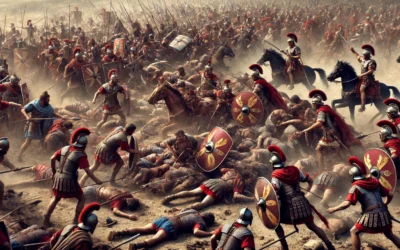
According to Livy and other ancient sources, the Roman formation was poorly conceived. The troops were deployed with their flank exposed to the river and with no depth to their lines. The Gauls, physically imposing and tactically aggressive, attacked with force. A shock assault on the Roman right, held by the less experienced units, led to immediate collapse. Panic spread rapidly, and much of the Roman army fled the field without offering sustained resistance.
The rout was complete. Thousands died in the melee or were drowned trying to cross the river. Survivors either fled to the city or scattered into the countryside. It was a humiliating defeat, unmatched in Roman history until centuries later.
The Path to Rome Left Open
With no army left to oppose them, the Gauls marched on Rome unchallenged. The city’s defenders, mostly older senators and young recruits, were no match for the seasoned warriors now surrounding their walls. Most Roman citizens took refuge in the fortified Capitoline Hill, while the rest of the city was abandoned.
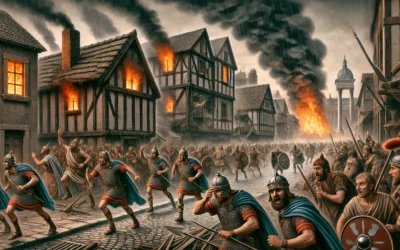
For days, the Gauls looted and burned. The sacred temples, homes, and civic buildings of Rome were reduced to ash. Livy tells of stoic senators awaiting their deaths in full regalia, seated in their homes as the barbarians cut them down—a tableau of honor and tragedy.
The Capitoline Siege and Roman Resistance
Though the city had fallen, the defenders on the Capitoline Hill held out. Using the natural fortifications of the hill and limited supplies, they repelled Gallic attempts to seize the stronghold. In one famous episode, geese sacred to Juno allegedly raised the alarm during a night assault, saving the defenders from surprise attack. The image of Rome’s salvation by divine animals became legendary.
After several months of stalemate, disease, famine, and the threat of reinforcements led Brennus to negotiate. The Romans agreed to pay a massive ransom of 1,000 pounds of gold to secure the Gauls’ withdrawal. When Roman officials protested the weights used, Brennus supposedly cast his sword onto the scale and declared: “Vae victis!” (“Woe to the vanquished!”)
The Aftermath: Humiliation and Recovery
The sack of Rome in 390 BCE left physical and psychological scars. The city was rebuilt quickly, but its confidence was shattered. The Romans vowed never to be caught unprepared again. They reinforced city walls, reorganized military recruitment, and prioritized rapid communication and defense. The trauma also instilled a deep fear and hatred of the Gauls that would influence Roman foreign policy for generations.
In later years, the story of the sack was often retold as a moment of both shame and resilience—a crucible through which the Roman spirit was reforged. Rome had been brought to its knees, but it had survived. That survival became part of the city’s mythic identity.
A Battle Etched in Roman Memory
The Battle of the Allia became synonymous with disaster. The date—July 18—was considered unlucky and was marked as a dies ater (“black day”) on the Roman calendar. For centuries, Romans would refer to the Allia when speaking of military collapse or divine punishment.
And yet, from that defeat emerged a more disciplined and hardened Rome. In the centuries that followed, it would absorb Gaul, defeat Hannibal, and become the world’s dominant power. But it never forgot the lessons of the Allia—that vigilance, unity, and preparation were the price of survival.