The dawn of the 17th century in Rome was a period of intense artistic and architectural flourishing, deeply influenced by the burgeoning Baroque style and the ambitions of the papacy. Amidst this vibrant era, one monumental undertaking reached its apex: the completion of the St. Peter’s Basilica Facade. Finished in 1614 under the direction of Carlo Maderno, this magnificent frontispiece did more than merely cap off decades of construction on the world’s largest church; it dramatically altered the visual landscape of the Vatican and established a new benchmark for grandeur in ecclesiastical architecture. Maderno’s design masterfully navigated the complex legacy of his predecessors, including the towering visions of Bramante and Michelangelo, while imbuing the structure with the dynamic energy characteristic of the nascent Baroque. This facade, a testament to papal authority and artistic innovation, would become an iconic symbol of Rome’s enduring spiritual and cultural power.
The Genesis of a Grand Vision: St. Peter’s Before Maderno
The construction of St. Peter’s Basilica was an epic undertaking, spanning over a century and involving some of the greatest artistic minds of the Renaissance. Pope Julius II laid the cornerstone in 1506, envisioning a magnificent new basilica to replace the ancient Constantinian structure. Donato Bramante, the initial chief architect, conceived a centralized Greek-cross plan, a testament to Renaissance ideals of harmony and proportion. However, after Bramante’s death, a succession of architects, including Raphael, Baldassare Peruzzi, and Antonio da Sangallo the Younger, struggled with the immense scale and complexity of the project, often proposing alternative designs.
Michelangelo’s Defining Contribution
It was Michelangelo Buonarroti who, taking over in 1546 at the age of 71, made perhaps the most impactful contribution to the basilica’s core structure. He returned decisively to Bramante’s centralized plan, simplifying and strengthening the design, particularly around the colossal dome. Michelangelo’s vision for the dome, while unfinished at his death in 1564, provided the structural and aesthetic backbone that would define St. Peter’s silhouette for centuries. His death left the basilica still without a completed nave or a definitive facade, setting the stage for the next phase of its evolution and the arrival of an architect who would bridge the gap between Renaissance classicism and Baroque dynamism.
Carlo Maderno’s Architectural Synthesis
In 1603, Pope Paul V Borghese appointed Carlo Maderno as the chief architect of St. Peter’s Basilica, tasking him with the monumental responsibility of completing the immense structure. Maderno inherited a basilica largely defined by Michelangelo’s central plan and majestic dome, but still lacking a full nave and an appropriate facade to house the “Loggia delle Benedizioni” (Loggia of Blessings), where the Pope would impart his urbi et orbi blessings.
Extending the Nave and Crafting the Facade
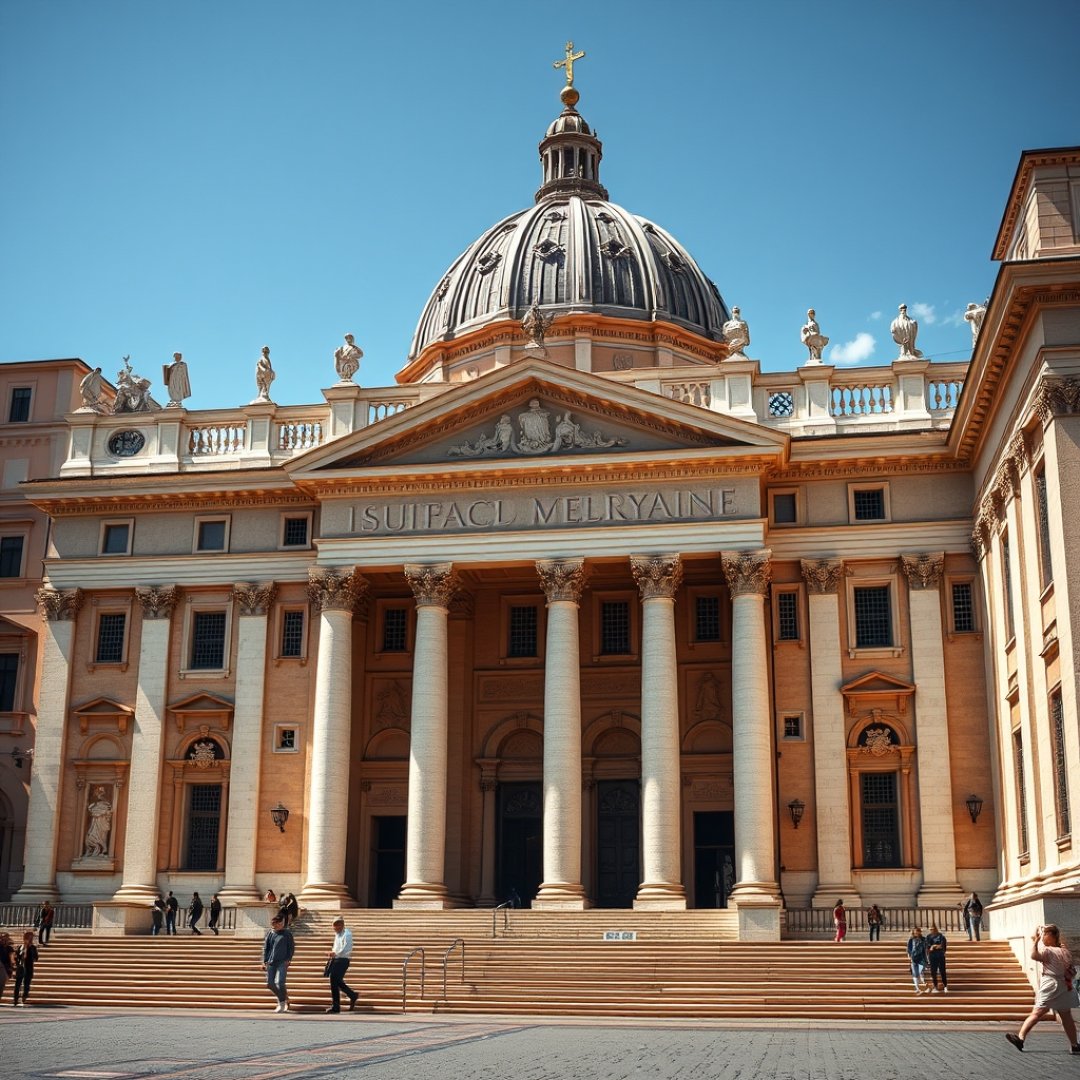
Maderno’s primary challenge was to reconcile Michelangelo’s centralized scheme with the Counter-Reformation’s preference for a longitudinal, Latin-cross plan, which was deemed more suitable for large congregations and processional liturgy. He extended the nave eastward, adding three bays that effectively pushed Michelangelo’s dome further back from the square. For the facade itself, completed in 1614, Maderno designed a monumental structure stretching 115 meters wide and 45 meters high. It features two orders of colossal Corinthian columns and pilasters, surmounted by a balustrade adorned with thirteen statues, depicting Christ the Redeemer, John the Baptist, and eleven Apostles. The central portal, topped by a grand papal loggia, was designed to emphasize the Pope’s direct connection to the divine. Despite criticisms regarding its width, which somewhat obscured the view of Michelangelo’s dome from St. Peter’s Square, Maderno’s design remains a powerful testament to the ambition and aesthetic of early Baroque Rome.
Legacy and Enduring Impact
The completion of the St. Peter’s Basilica Facade in 1614 marked a significant moment not only for the Vatican but for the history of architecture. Carlo Maderno’s work successfully brought to fruition a project that had consumed generations of artists and popes, transforming an ancient site into the spiritual heart of Catholicism as we know it today. His design seamlessly integrated with the existing colossal scale while introducing elements that foreshadowed the full-blown Baroque exuberance that would soon dominate Roman art and architecture.
Shaping the Piazza and Roman Identity
Although Maderno’s facade was sometimes criticized for its breadth, which partly concealed Michelangelo’s dome from certain perspectives in the square, it ultimately laid the groundwork for the future development of St. Peter’s Square. Gian Lorenzo Bernini, Maderno’s nephew and successor, would later design the iconic colonnade that gracefully embraces the vast piazza, creating a dramatic approach to the basilica and cleverly mitigating the facade’s perceived shortcomings. The facade continues to serve as the backdrop for countless historic events, embodying the enduring power of the papacy and the eternal city’s capacity for architectural magnificence. It stands as a timeless symbol of faith, art, and the intricate dialogue between tradition and innovation that defined Rome.
Frequently Asked Questions
Who commissioned the St. Peter’s Basilica Facade?
The St. Peter’s Basilica Facade was commissioned by Pope Paul V Borghese, who appointed Carlo Maderno as chief architect in 1603 to complete the grand basilica.
What were the main architectural challenges Maderno faced?
Maderno’s primary challenge was to extend Michelangelo’s centralized Greek-cross plan into a longitudinal Latin-cross nave, as preferred by the Counter-Reformation, while also designing a facade that harmonized with the existing colossal scale and housed the papal Loggia of Blessings.
How long did it take to complete the facade?
The facade itself was largely completed between 1607 and 1614, marking a relatively swift culmination of this particular phase of the basilica’s century-long construction.
What architectural style is the St. Peter’s Basilica Facade?
The St. Peter’s Basilica Facade is primarily designed in the early Baroque style, characterized by its colossal order of columns, dynamic interplay of light and shadow, and grand scale, yet it retains strong classical influences from the High Renaissance.
Did Carlo Maderno design the entire St. Peter’s Basilica?
No, Carlo Maderno did not design the entire St. Peter’s Basilica. He inherited the project after several architects, most notably Donato Bramante and Michelangelo, had established much of its foundational design, including Michelangelo’s iconic dome. Maderno was responsible for extending the nave and designing the facade.