Introduction: The Last Emperor Crowned by a Pope
On February 24, 1530, Charles V, ruler of a vast empire stretching from Europe to the Americas, was crowned Holy Roman Emperor by Pope Clement VII in Bologna. This momentous event symbolized not only the height of Charles’s power but also the waning tradition of papal coronations for emperors. It marked the last time in history a Holy Roman Emperor would be crowned by the pope himself, underscoring a pivotal transition in the political and religious dynamics of Renaissance Europe.
Background: An Empire Without an Emperor
Following the death of Emperor Maximilian I in 1519, the imperial title passed to his grandson Charles V. Elected by the prince-electors of the Holy Roman Empire, Charles faced numerous challenges in consolidating his rule: from rival claims by Francis I of France to the rising Protestant Reformation sparked by Martin Luther’s theses in 1517. Though Charles had been elected emperor, the tradition of papal coronation had not yet been fulfilled, leaving a symbolic void in his authority.
The Road to Bologna
Initially, Charles’s relationship with the papacy was strained, especially after the catastrophic Sack of Rome in 1527 by his mutinous troops. However, political necessity forced reconciliation. Pope Clement VII, seeking stability and protection against France and the Ottomans, agreed to crown Charles. Bologna, rather than Rome, was chosen as the coronation site due to the devastation still lingering in the Eternal City.
The Coronation Ceremony
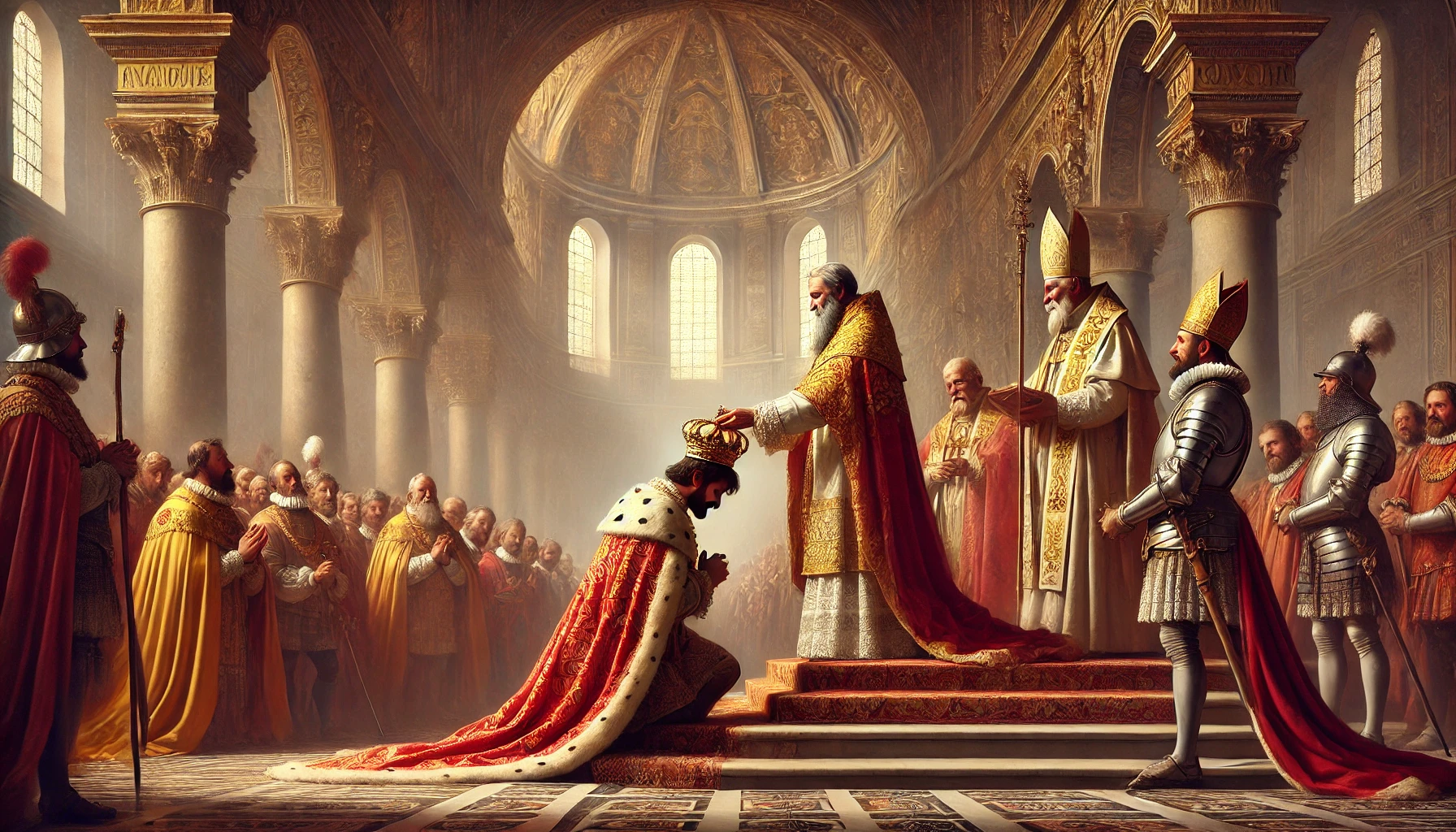
The coronation took place inside the Basilica of San Petronio, a grand Gothic structure in the heart of Bologna. In a lavish ceremony filled with Renaissance pageantry, Charles V knelt before Clement VII, who placed the imperial crown upon his head. The event was rich in symbolism: a unification of secular and spiritual authority, albeit one already fraying at the edges as Europe moved towards modern nation-states and religious fragmentation.
Political and Religious Implications
Charles’s coronation represented a temporary strengthening of the traditional ideal of a universal Christian empire. Yet, even as he donned the imperial crown, the forces of Protestant reform and national sovereignty were reshaping Europe. Charles would spend much of his reign fighting to preserve Catholic unity and imperial supremacy—battles he would ultimately lose, culminating in his abdication in 1556.
Charles V’s Global Empire
Charles V ruled over an unprecedented expanse of territories: Spain, the Netherlands, parts of Italy, Austria, and vast holdings in the Americas. His reign saw both remarkable expansion and intense conflicts, from wars with France and the Ottomans to the struggles of the Protestant Reformation. His dream of a united Christendom faded under the pressures of emerging modern states and divergent religious identities.
The End of an Era
The Bologna coronation was the last instance of a pope crowning a Holy Roman Emperor. Future emperors, like Ferdinand I and his successors, would assume the title without direct papal intervention. The ceremony of 1530 thus stands as a historical watershed—a final echo of the medieval ideal of a Christendom united under both emperor and pope.
Conclusion: A Moment of Glory Amidst Changing Times
The coronation of Charles V in Bologna captured a fleeting moment when imperial and papal ambitions still appeared intertwined. Yet beneath the gold and ceremony, the currents of change were unstoppable. Renaissance Europe was giving way to the modern world, and the unity symbolized by Charles’s crown would soon fragment into a continent defined by nation-states, religious wars, and new ideologies. His coronation was both a crowning achievement and a poignant farewell to an older vision of empire.