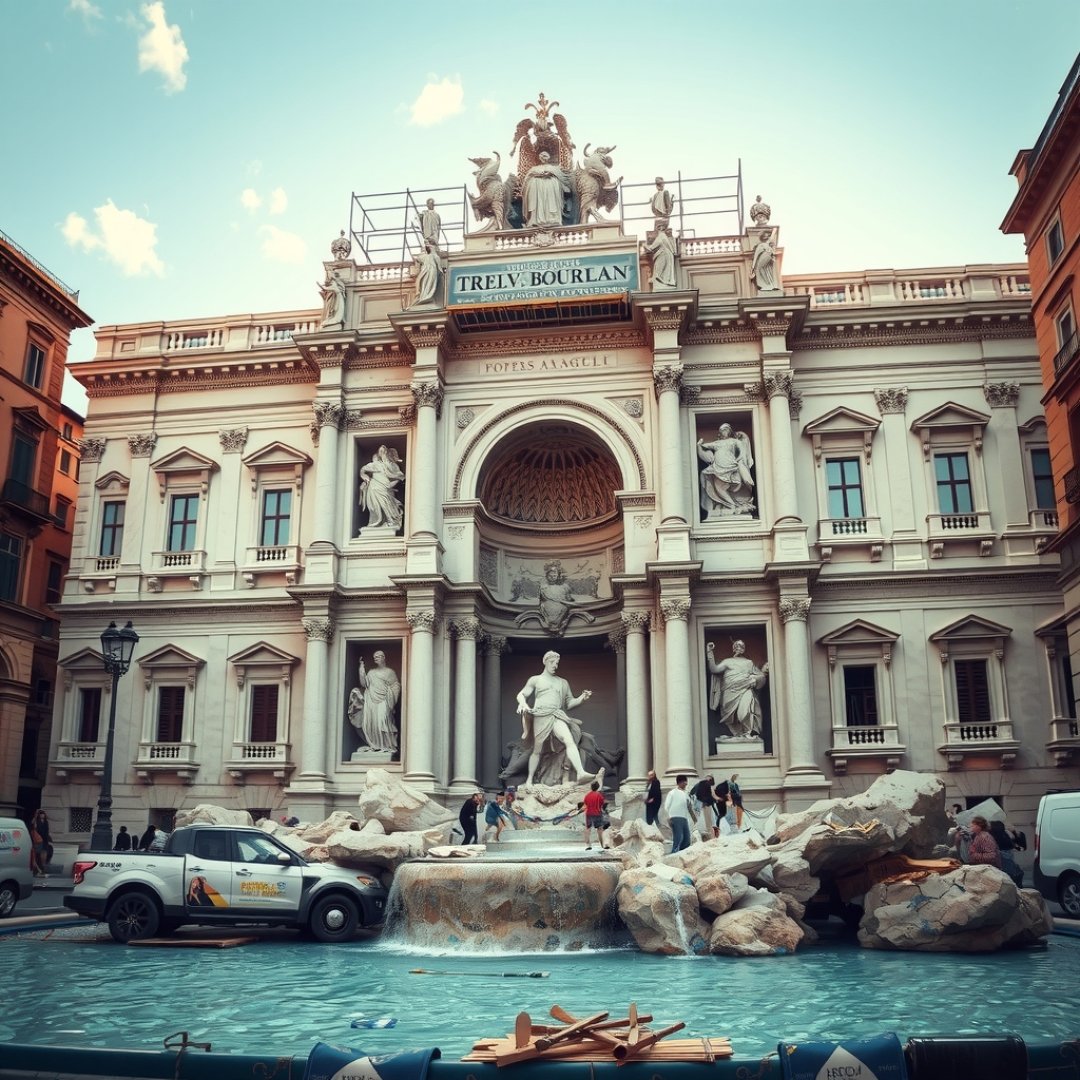
In the vibrant heart of 18th-century Rome, 1734 marked a significant period in the genesis of one of the Eternal City’s most enduring symbols: the Trevi Fountain. While its completion would take decades, this year saw crucial advancements in the ambitious Trevi Fountain construction project initiated by Pope Clement XII. Having inherited a city still striving to reclaim its ancient glory through monumental art and architecture, Clement XII envisioned a grand fountain at the terminus of the Aqua Virgo aqueduct, replacing the modest existing basin. The decision to undertake such a colossal public work in the early 1730s was a bold statement of papal power and aesthetic ambition, aiming to create a Baroque masterpiece that would captivate future generations and solidify Rome’s reputation as a cultural capital. The undertaking involved intense competition, innovative engineering, and considerable financial planning, all of which were actively underway during this formative year.
The Legacy of Aqua Virgo and Papal Ambition
The story of the Trevi Fountain begins not in the 18th century, but with the ancient Aqua Virgo aqueduct, originally commissioned by Marcus Vipsanius Agrippa in 19 BC. This vital water source had continuously supplied Rome for nearly two millennia, terminating at various points over the centuries. By the early 1700s, the area where the Trevi Fountain now stands had a simple, somewhat dilapidated fountain, a far cry from the grand visions of the Baroque era. Pope Clement XII, elected in 1730, was a keen patron of the arts and acutely aware of Rome’s potential for architectural splendor. He decided to replace the existing structure with something truly magnificent, a fitting tribute to both the ancient Roman engineering feat of the Aqua Virgo and the contemporary artistic prowess of his pontificate. This decision sparked a major artistic competition, inviting Rome’s leading architects to submit designs for what would become a monumental public spectacle.
The Competition’s Genesis
The initial idea for a grand fountain at this site had been pondered by previous pontiffs, including Pope Urban VIII and Gian Lorenzo Bernini, who even began preliminary work on a different design. However, it was Clement XII who brought the project to fruition. In 1730, he launched a highly publicized design competition. Prominent architects like Ferdinando Fuga and Nicola Salvi submitted elaborate plans. The Pope’s choice was not merely an artistic preference but a strategic decision to project an image of power and prosperity, cementing his legacy in the fabric of Rome.
Nicola Salvi’s Baroque Masterpiece Takes Shape
After considerable deliberation, Nicola Salvi’s ambitious design was selected, reportedly due to its dramatic theatricality and integration with the existing Palazzo Poli façade. Salvi, though not as famous as some of his contemporaries, proved to be an inspired choice. His vision for the Trevi Fountain was a colossal undertaking, featuring a central figure of Oceanus in a shell-shaped chariot, pulled by hippocampi and tritons, all set against a richly sculpted architectural backdrop. The initial phases of the Trevi Fountain construction began in 1732, but 1734 saw significant groundwork and the beginning of the sculptural elements. This period involved extensive preparations, including reinforcing the foundations and carving the massive travertine blocks that would form the fountain’s intricate structure. Salvi meticulously supervised every detail, drawing heavily on Baroque aesthetics that emphasized movement, emotion, and dramatic scale.
Challenges and Artistic Influences
The sheer scale of Salvi’s design presented considerable engineering and logistical challenges. Transporting the enormous blocks of travertine from Tivoli to Rome was a monumental task, requiring innovative solutions. Furthermore, Salvi’s design incorporated elements reminiscent of Bernini’s unrealized projects, demonstrating a continuity in the Roman Baroque tradition while also pushing its boundaries. The initial years of the Trevi Fountain construction were crucial for establishing the artistic and structural integrity of the entire monument, laying the foundation for what would become an unparalleled example of public art.
Financing the Grandeur: Papal Patronage in the 18th Century
Projects of this magnitude, even in papal Rome, required substantial financial backing. The Trevi Fountain construction was no exception. Pope Clement XII famously funded the initial phases of the project, including much of the work happening in 1734, by reinstating the lottery in Rome and imposing new taxes, particularly on wine. This method of financing was a common, albeit sometimes unpopular, practice for papal patronage of major public works during this period. The investment was seen as crucial for the beautification of the city and for enhancing the prestige of the Papacy.
Economic Impact and Legacy
While the taxes might have been a burden on some, the project also created numerous jobs for masons, carvers, laborers, and artists, injecting money into the Roman economy. The construction of such a landmark was not just about aesthetics; it was a civic project that provided employment and showcased Rome’s continued vitality and cultural leadership. The decision to invest heavily in the Trevi Fountain in 1734, amidst other political and economic considerations of the era, underscores the enduring importance of art and monumental architecture in the projection of power and identity for the Eternal City.
Frequently Asked Questions
Who was the Pope that commissioned the Trevi Fountain’s major reconstruction?
Pope Clement XII commissioned the major reconstruction of the Trevi Fountain in the early 18th century, initiating the design competition in 1730.
When did the Trevi Fountain construction officially begin with Nicola Salvi’s design?
The official construction of the Trevi Fountain, based on Nicola Salvi’s winning design, began in 1732, with significant progress made in years like 1734.
What ancient Roman aqueduct supplies the Trevi Fountain?
The Trevi Fountain is supplied by the Aqua Virgo aqueduct, an ancient Roman water channel originally constructed by Marcus Vipsanius Agrippa in 19 BC.