
Weighing Rome’s People and Power
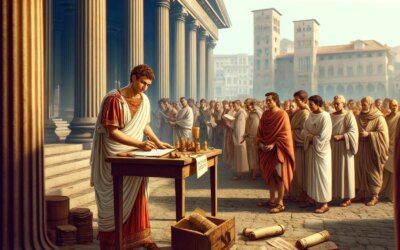
Every five years during the Roman Republic, citizens gathered at the Campus Martius, the sprawling field north of the city center, to stand before the magistrates known as censors. This event was not a religious festival or public spectacle, but something more fundamental: the census. Instituted in the earliest days of the Republic, the census ranked Rome’s people, shaped its politics, and laid the foundations for military, fiscal, and social order. It was a moment when every Roman had to account not only for their wealth but for their place within the collective body of the state.
Origins and Purpose of the Roman Census
The Roman census was introduced by King Servius Tullius in the 6th century BCE as part of his reorganization of the army and state. By the Republican era, it had become a keystone of Roman governance. Conducted typically every five years (a period called a lustrum), the census had several crucial functions:
- It assessed citizens’ property and wealth for purposes of taxation.
- It determined military obligations and unit assignments.
- It established voting rights and political status within the comitia centuriata (the centuriate assembly).
- It registered family members, slaves, and dependents, reinforcing the patriarchal structure of Roman society.
In essence, the census turned citizens into data—an organized, countable population through which the Republic governed itself.
The Role of the Censors
The censors were among the most respected magistrates in the Republic, elected every five years from among former consuls. Their role extended beyond the census to include public morality, oversight of senatorial membership, and supervision of public works and contracts. In conducting the census, censors wielded extraordinary authority, not only to classify citizens but to mark moral infractions through the infamous nota censoria, a public black mark that could lead to social disgrace or expulsion from the Senate.
Their power was moral as much as administrative, symbolizing the Republic’s belief that order stemmed not only from law but from virtue.
The Process of Registration
On the appointed day, male citizens would appear before the censors in the Campus Martius. Each head of household, or paterfamilias, was required to declare his name, age, occupation, place of residence, and the names and status of his family members and slaves. Crucially, he had to report his property holdings—land, livestock, buildings, and other assets. These declarations were made under oath, and false reporting was punishable by fines or loss of status.
Citizens were then assigned to one of the centuriae, or centuries—a division used not only for military conscription but for voting in the centuriate assembly. The wealthier classes received more centuries, and thus greater political influence. The census was, therefore, a mechanism of oligarchic control masked as democratic participation.
Class and Identity in the Roman Republic
Rome’s society was rigidly stratified. The census reinforced these divisions by codifying them into law. At the top stood the senatorial class, followed by the equestrians (wealthy horse-owning citizens), and then the plebeians—common citizens. At the bottom were proletarii, citizens without sufficient property to serve in the army, who had limited political weight.
Class status determined not only a citizen’s political clout but also their military role. The wealthiest fought as cavalry, the middle ranks as heavily armed infantry, and the poorest as light troops or auxiliaries. The census, therefore, linked military duty, political voice, and social class into a single institutional frame.
Women, Slaves, and the Excluded
Roman women, though crucial to family and lineage, were not individually counted in the census. Instead, they were listed under the authority of a male paterfamilias. Slaves were registered as property, reinforcing their dehumanized legal status. Freedmen—former slaves granted citizenship—were included, but often ranked in lower voting classes and barred from holding office.
The census thus mirrored and reinforced the patriarchal and hierarchical norms of the Republic. It was as much a ritual of exclusion as of inclusion, mapping not only the citizenry but the social order.
Civic Ritual and the Lustrum
At the conclusion of the census, the censors performed a religious ceremony called the lustratio, or lustrum—a purification of the city and people. This ritual, held at the altar of Mars, involved the sacrifice of a pig, a sheep, and a bull (the suovetaurilia) to purify the army and renew the moral contract of the citizenry. The lustrum was a moment of renewal, symbolizing both the power of order and the divine favor upon a well-regulated state.
Decline and Legacy
As the Republic gave way to empire, the census evolved. Under Augustus, the process was centralized and adapted for an empire-wide scale, though its civic and military functions were gradually diminished. Nevertheless, censuses continued well into the imperial period, even influencing later Byzantine and medieval administrative systems.
Modern censuses—while democratic and secular—inherit much from Rome’s precedent: the use of population data to distribute political power, plan taxation, and organize the state. The Roman census was not merely a headcount—it was a mirror in which Rome saw itself, ordered its people, and proclaimed its values.
Memory in Marble and Manuscript
Though no complete census records survive from the Republic, references in Livy, Cicero, and inscriptions allow historians to piece together its function. The idea of a government counting and classifying its citizens, assigning identity and responsibility through a bureaucratic process, is a Roman legacy that shapes how societies imagine citizenship even today.
The Cloaca Maxima drained the city’s waste—but the census organized its soul. In the quiet lines of citizens on the Campus Martius, Rome counted its people and defined its destiny.