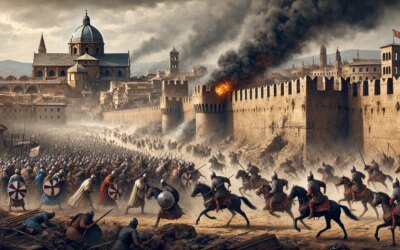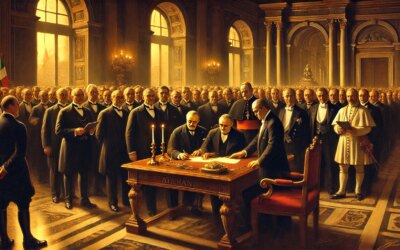

In the complex tapestry of 19th-century European politics, the future of the city of Rome, known as the ‘Roman Question,’ was a thorny issue, intricately tied to the broader movement of Italian unification, known as the Risorgimento. For years, French troops had been stationed in Rome, acting as protectors of the Papal States and Pope Pius IX against the burgeoning Kingdom of Italy’s ambition to make Rome its capital. This delicate balance of power, marked by fervent nationalism and religious authority, reached a significant diplomatic juncture with the signing of the September Convention of 1864. This agreement, forged between the French Empire under Napoleon III and the newly formed Kingdom of Italy, represented a pivotal, albeit temporary, redefinition of Rome’s status and signaled a crucial moment in the long path towards Italian unity, influencing the city’s destiny in profound ways.
The French Presence and the Roman Question’s Origins
Following the suppression of the Roman Republic in 1849, French forces under Napoleon III remained in Rome to safeguard the temporal power of Pope Pius IX. This intervention was driven by a mix of factors:
- Domestic French Politics: Napoleon III sought to appease powerful Catholic factions within France.
- European Balance of Power: A desire to prevent Italian unification from proceeding too rapidly or becoming too powerful without French influence.
- Papal Sovereignty: The perceived need to protect the Pope’s independence as a spiritual and temporal ruler.
The continuous presence of a foreign army in the heart of the Italian peninsula, preventing the unification of its historical capital, created the ‘Roman Question’ – a major diplomatic and nationalistic challenge for the nascent Kingdom of Italy. The city of Rome was seen as the natural capital by Italian patriots, but its occupation by French troops made its acquisition impossible without a direct confrontation with France.
Negotiating the Terms of the September Convention
By the early 1860s, the ongoing French occupation was becoming a political liability for Napoleon III, both internationally and within France. Diplomatic negotiations between the French Empire and the Kingdom of Italy intensified, leading to the signing of the September Convention of 1864 in Paris. Key figures such as Italian Prime Minister Marco Minghetti and French Foreign Minister Édouard Drouyn de Lhuys played crucial roles. The core stipulations of the agreement were:
- French Withdrawal: France committed to withdrawing its troops from Rome within two years.
- Italian Non-Interference: Italy pledged to respect the existing borders of the Papal States and not attack its territory.
- Florence as Capital: As a show of good faith and to demonstrate that Italy had abandoned its designs on Rome, the Italian capital would be moved from Turin to Florence.
- Papal Self-Defense: The Papacy would be allowed to recruit its own army to maintain order and defend its borders.
This convention aimed to de-escalate tensions and provide a diplomatic solution to the Roman Question, at least on paper.
Immediate Impact and Unforeseen Consequences
The September Convention of 1864 had immediate and far-reaching effects:
Political Realignments
The agreement was met with mixed reactions. While it temporarily relieved Napoleon III of the burden of maintaining troops in Rome, it caused riots in Turin due to the capital transfer. For the Papacy, it offered a brief respite and the opportunity to strengthen its own forces, such as the Pontifical Zouaves. However, many Italian nationalists saw it as a betrayal of their ambition to claim Rome.
The Move to Florence
The transfer of Italy’s capital to Florence in 1865 was intended to signal a permanent shift away from Rome. However, it was widely understood by many as a provisional measure, a stepping stone rather than a definitive renunciation. This strategic relocation created a period of administrative and political transition for the fledgling kingdom.
A Temporary Solution
Ultimately, the September Convention proved to be a temporary solution. While French troops did eventually withdraw, the underlying ‘Roman Question’ remained unresolved. The convention implicitly acknowledged the Papal States as a sovereign entity but did little to quell Italian nationalistic aspirations for Rome. The events of 1870, particularly the Franco-Prussian War, would soon disrupt the fragile peace established by the convention, leading to the final annexation of Rome by Italy and the end of papal temporal power.
Frequently Asked Questions
What was the main purpose of the September Convention of 1864?
The main purpose of the September Convention of 1864 was to resolve the ‘Roman Question’ by stipulating the withdrawal of French troops from Rome and securing a pledge from the Kingdom of Italy to respect the Papal States’ borders, thereby preserving papal temporal power, at least temporarily.
Who were the primary parties involved in the September Convention of 1864?
The primary parties involved in the September Convention of 1864 were the French Empire, led by Emperor Napoleon III, and the Kingdom of Italy, represented by its government, with key negotiations involving figures like Italian Prime Minister Marco Minghetti.
How did the September Convention of 1864 impact the capital of Italy?
As a direct consequence of the September Convention of 1864, the capital of the Kingdom of Italy was moved from Turin to Florence in 1865. This move was intended to demonstrate Italy’s commitment to respecting the Papal States and abandoning its immediate claims on Rome.
Did the September Convention of 1864 permanently secure the Papal States?
No, the September Convention of 1864 did not permanently secure the Papal States. While it provided a temporary diplomatic solution and a period of relative peace, the underlying nationalistic desire for Rome to be the capital of a unified Italy persisted. The final annexation of Rome occurred in 1870.
What was the ultimate fate of the French garrison in Rome after the convention?
The French garrison did withdraw from Rome in accordance with the September Convention of 1864. However, some French troops were redeployed to the Papal States during the Mentana campaign in 1867. The permanent French military presence in Rome ended only in 1870, when Napoleon III recalled his troops due to the Franco-Prussian War, which then allowed Italy to take the city.