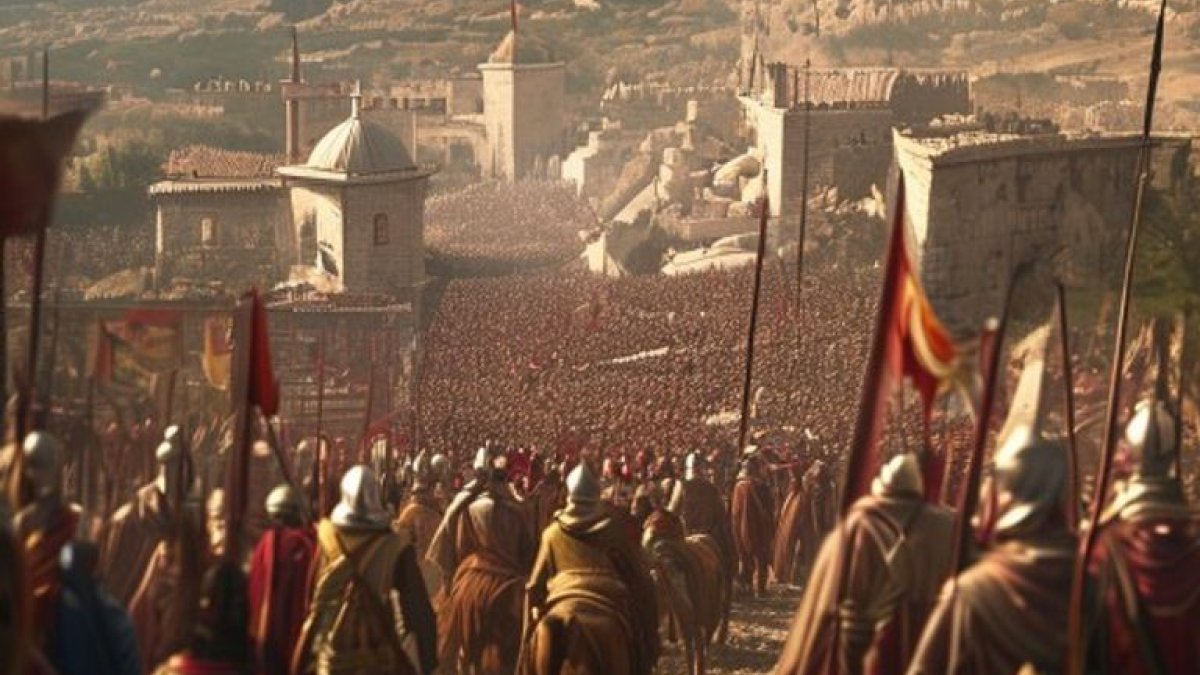
In the tumultuous early 7th century, the Eastern Roman (Byzantine) Empire found itself facing existential threats on multiple fronts, with the resurgent Sasanian Persian Empire driving deep into its territories. Among the most alarming developments was the Siege of Chalcedon in 617 AD, an event that brought the full horror of the Persian advance to the very doorstep of Constantinople. Situated strategically on the Asian shore of the Bosphorus, directly opposite the imperial capital, Chalcedon’s fall represented not just a loss of territory but a chilling psychological blow, signaling Persia’s near-complete encirclement of the Byzantine heartland. Emperor Heraclius, still struggling to consolidate his power and reform the shattered Byzantine armies, watched as the Persian forces under Shahin Vahmanzadegan established a formidable presence, threatening to cross the narrow strait and launch a direct assault on the world’s most impregnable city. This period marked one of the darkest hours for Byzantium, underscoring the desperate need for a strategic shift that would ultimately lead to Heraclius’s dramatic counter-offensives later in the decade, but for now, the shadow of Persian power loomed large.
The Escalation of the Byzantine-Sasanian War
A Decade of Persian Domination
By 617 AD, the Byzantine Empire had endured nearly two decades of relentless warfare against its ancient rival, the Sasanian Persian Empire. The conflict, reignited in 602 AD by Shah Khosrow II in response to the usurpation and murder of Emperor Maurice, had seen Byzantine territories systematically overrun. Persia’s initial successes were staggering; they conquered much of Mesopotamia, Syria, Palestine, and even Egypt. Key cities like Antioch, Damascus, and Jerusalem had fallen, with the latter’s capture in 614 AD being a particularly devastating blow, as the Persians seized the relic of the True Cross, a profound spiritual loss for the Christian empire.
Emperor Heraclius, who had only seized the throne in 610 AD, inherited an empire on the brink of collapse. His initial years were consumed by internal instability and the overwhelming task of simply surviving the Persian onslaught. The Sasanians, under skilled generals like Shahin and Shahrbaraz, were not merely raiding but permanently occupying vast swathes of Byzantine land, systematically dismantling the imperial administration and imposing their own rule. The stage was set for an even more direct threat to the very heart of Byzantium.
The Strategic Importance of Chalcedon
The Gateway to Constantinople
Chalcedon, known today as Kadıköy, held immense strategic significance during this period. Located on the eastern shore of the Bosphorus Strait, it lay directly opposite Constantinople, separated only by a narrow body of water. For centuries, its position had made it a vital military and commercial hub, a crucial checkpoint for traffic moving between Asia and Europe. The city itself possessed strong fortifications, but its ultimate value was its proximity to the imperial capital. From Chalcedon, Persian forces could observe Byzantine movements within Constantinople, project power across the strait, and, crucially, serve as a base for a potential direct assault or blockade of the capital.
The fall of Chalcedon would mean that hostile forces were literally within sight of Constantinople’s formidable Theodosian Walls. The psychological impact alone would be immense, as citizens looked across the water to see the banners of their enemies flying. Furthermore, a permanent Persian presence there could disrupt vital sea lanes, threaten food supplies, and further isolate the beleaguered capital, making it a critical target in the ongoing war.
The Siege and Fall in 617 AD
Shahin’s Encirclement
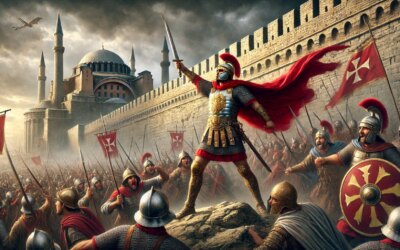
In 617 AD, the Sasanian general Shahin Vahmanzadegan, who had already achieved significant victories in Asia Minor, led his forces to Chalcedon. The siege itself was a demonstration of Persian military prowess and their determination to bring the war to Byzantium’s ultimate stronghold. While the precise details of the siege operations are scarce, it is known that the city eventually capitulated. The Byzantines, weakened by years of conflict and unable to mount an effective relief force, likely faced overwhelming odds.
The fall of Chalcedon was a stark moment of truth for Heraclius. With Persian forces now occupying a fortified position directly opposite his capital, the threat of an imminent invasion of Constantinople became terrifyingly real. Sources suggest that during this period, Heraclius even considered relocating the capital to Carthage, a testament to the dire and existential nature of the crisis. The Persians were not just at the gates; they were staring across the Bosphorus, almost within spitting distance of the imperial palace.
A Humiliating Peace and Future Resolve
A Costly Interlude and the Seeds of Reconquest
Following the capture of Chalcedon, the Persians continued to press their advantage. Heraclius, realizing the impossibility of a military victory at that moment, was forced into humiliating negotiations. He dispatched envoys to Shahin, and even directly to Shah Khosrow II, offering tribute and peace in exchange for an end to hostilities. The terms demanded by Khosrow were exorbitant and deeply insulting, reflecting his view of Heraclius as a mere vassal.
According to some accounts, Khosrow demanded Heraclius’s abdication and conversion to Zoroastrianism, and famously declared that he would not grant peace until Heraclius and all his people rejected the crucified God and worshipped the sun. While these negotiations ultimately failed to secure lasting peace, the dire circumstances, including the constant threat from Chalcedon, provided Heraclius with a crucial, albeit painful, period to consolidate his power, reorganize the Byzantine military, and implement sweeping financial reforms. It was this desperate period, directly following events like the Siege of Chalcedon in 617 AD, that forged the resolve within Heraclius to launch the audacious counter-offensive that would, against all odds, turn the tide of the Byzantine-Sasanian War in the years that followed.
Frequently Asked Questions
Why was Chalcedon so important strategically?
Chalcedon was crucial because of its location directly across the Bosphorus Strait from Constantinople. Its control allowed Persian forces to directly observe, threaten, and potentially launch an assault on the Byzantine capital, or at least severely disrupt its maritime trade and supply lines.
Who was the Sasanian general responsible for the Siege of Chalcedon in 617 AD?
The Sasanian general Shahin Vahmanzadegan led the Persian forces that besieged and captured Chalcedon in 617 AD. Shahin was one of Khosrow II’s most successful commanders during the early phases of the Byzantine-Sasanian War.
How did Emperor Heraclius respond to the fall of Chalcedon?
Heraclius was in a desperate position. With Persian forces so close, he attempted to negotiate for peace, offering significant tribute. However, the Sasanian Shah Khosrow II’s terms were so humiliating and unrealistic that Heraclius ultimately refused, instead using the respite to initiate crucial military and financial reforms to rebuild his empire’s capacity for war.
What was the broader impact of the Siege of Chalcedon on the Byzantine-Sasanian War?
The Siege of Chalcedon in 617 AD symbolized the near-complete encirclement of Constantinople and the dire state of the Byzantine Empire. It was a major psychological blow and highlighted the existential threat. However, it also hardened Heraclius’s resolve, pushing him to implement the reforms and embark on the counter-offensives that eventually turned the tide of the war in Byzantium’s favor.