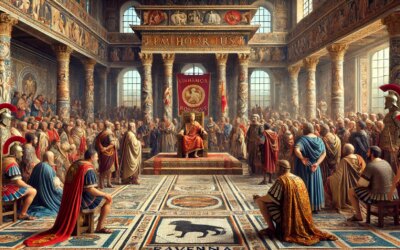

In the turbulent early 5th century, as the Western Roman Empire reeled from the Sack of Rome in 410 AD, its periphery became a hotbed of ambition and instability. Against this backdrop, a minor Gallic aristocrat named Jovinus emerged, proclaiming himself emperor in 411 AD. The Usurpation of Jovinus 411 represents a fascinating, albeit short-lived, challenge to the authority of Emperor Honorius, highlighting the fragmentation of Roman power in Gaul. This period was characterized by desperate imperial attempts to maintain control, the shifting allegiances of barbarian federates, and the relentless pressure on an empire already on its knees. Jovinus’s rise and fall offer a poignant snapshot of the political and military complexities that hastened the decline of Roman rule in the west, as local elites, backed by barbarian warlords, sought to carve out their own destinies in a collapsing world.
Gaul in Chaos: The Seeds of Usurpation
Following the catastrophic Sack of Rome by Alaric’s Visigoths in 410 AD, the Western Roman Empire was left severely weakened and demoralized. Its hold on the provinces, particularly Gaul, became tenuous. The official imperial presence, largely centered around Ravenna, struggled to assert control over a region plagued by internal rebellions, barbarian incursions, and a populace increasingly disillusioned with imperial protection. Local Roman aristocrats, military commanders, and even barbarian chieftains saw an opportunity in this power vacuum. Several usurpers had already risen and fallen in rapid succession, reflecting the profound instability and the desperate search for strong leadership—or at least, a figurehead—in a crumbling political landscape.
The Rise of a Local Claimant
It was into this environment that Jovinus, a Gallo-Roman senator, stepped forward. Capitalizing on the widespread discontent and the absence of effective imperial authority, Jovinus was proclaimed emperor in Moguntiacum (modern Mainz) in 411 AD. His immediate appeal stemmed from his local connections and the promise of more direct governance and defense against the barbarian groups that roamed Gaul. His proclamation was a clear indicator that the traditional mechanisms of imperial succession had utterly broken down, replaced by regional power plays and opportunistic bids for the purple.
Barbarian Alliances and Shifting Loyalties
Jovinus’s initial success was largely predicated on forging alliances with powerful barbarian groups who had settled or were operating within Roman Gaul. Foremost among his early supporters were the Burgundians, led by their king Gundahar, and the Alans, under King Goar. These groups, often settled as federates, were looking for a patron who could legitimize their presence and perhaps grant them more territory or resources. Jovinus offered such a prospect, positioning himself as a local alternative to the distant and seemingly impotent court of Honorius.
The Visigothic Factor
- Athaulf’s Ambivalence: The most significant barbarian player in the region was Athaulf, Alaric’s brother-in-law and successor, who led the Visigoths. Initially, Athaulf considered supporting Jovinus, potentially seeing him as a means to secure a better deal for his people within the empire.
- Failed Negotiations: However, negotiations between Jovinus and Athaulf ultimately broke down. Jovinus made a critical misstep by elevating his brother Sebastianus to the rank of Augustus without consulting Athaulf, signaling a lack of respect for the Visigothic king’s influence and effectively insulting him.
- Shifting Allegiance: This diplomatic failure proved fatal for Jovinus. Athaulf, offended, soon entered into an alliance with Honorius, whose generals promised the Visigoths supplies and land in exchange for their assistance in suppressing the usurper.
The Imperial Response and Jovinus’s Downfall
Emperor Honorius, though often criticized for his ineffective rule, was not entirely idle. He dispatched his capable magister militum, Constantius (who would later become Emperor Constantius III), to deal with the various usurpers in Gaul. Constantius, a shrewd military commander and politician, understood the complex web of alliances and rivalries among the barbarian groups.
Constantius’s Strategy and Victory
Constantius exploited the strained relationship between Jovinus and Athaulf. By offering the Visigoths a formal treaty and supplies, he secured their military aid against Jovinus. Athaulf, eager to establish his people within the empire and secure resources, agreed to the alliance. In 413 AD, the Visigothic forces, now aligned with Honorius, marched against Jovinus. They quickly defeated and captured Jovinus’s brother Sebastianus, who was promptly executed. Jovinus himself fled to Valentia, where he was besieged and eventually captured by Athaulf’s forces.
The End of a Usurper
Jovinus was taken to Narbo (Narbonne), where he was executed in 413 AD. His head, along with those of other usurpers, was sent to Honorius at Ravenna and then displayed in Carthage, a brutal message to any other ambitious individuals contemplating a challenge to imperial authority. The swift and decisive end to the Usurpation of Jovinus 411 demonstrated that while imperial power was severely diminished, it could still, with strategic barbarian alliances, assert its will.
The Aftermath: A Precedent for Future Fragmentation
The suppression of Jovinus’s usurpation temporarily stabilized Gaul for Honorius, but it also highlighted the fundamental shifts in power that were occurring. The reliance on barbarian federates like the Visigoths to enforce imperial authority was a double-edged sword, granting them greater legitimacy and influence within Roman territories. The Visigoths, having played a key role in crushing Jovinus, eventually settled in Aquitaine, establishing a kingdom that would become increasingly independent of Ravenna.
Long-Term Implications
- Barbarian Kingdoms: The episode demonstrated that barbarian groups were no longer merely invaders but critical players in Roman politics, capable of deciding the fate of emperors. This set a precedent for the eventual establishment of more independent barbarian kingdoms within the former Roman provinces.
- Weakened Central Authority: Despite the imperial victory, the constant need to fight usurpers and negotiate with barbarian factions further drained the Western Empire’s resources and eroded its central authority.
- Gallic Identity: For Gaul, the usurpation reflected a growing regional identity and the willingness of local elites to seek solutions outside the traditional imperial framework, foreshadowing the eventual complete separation from Roman rule.
The Usurpation of Jovinus 411, though minor in the grand sweep of Roman history, was a significant symptom of the empire’s terminal decline, illustrating the fractured political landscape and the irreversible rise of barbarian power in the West.
Frequently Asked Questions
Who was Jovinus and when did he declare himself emperor?
Jovinus was a Gallo-Roman aristocrat who declared himself emperor in 411 AD in Moguntiacum (modern Mainz), capitalizing on the political instability and weakness of Emperor Honorius’s rule in the Western Roman Empire.
Which barbarian groups initially supported Jovinus?
Jovinus initially gained the support of the Burgundians, led by King Gundahar, and the Alans, under King Goar. These groups saw an opportunity to secure their positions and territories within Roman Gaul by backing a local claimant.
How did the Visigoths under Athaulf become involved in Jovinus’s downfall?
Athaulf, the Visigothic king, initially considered an alliance with Jovinus but was alienated when Jovinus elevated his brother Sebastianus without consulting him. Athaulf then allied with Emperor Honorius’s general, Constantius, who promised the Visigoths supplies and land in exchange for their military aid against the usurper. This alliance proved decisive.
What was the ultimate fate of Jovinus?
Jovinus was besieged in Valentia (Valence) by Athaulf’s forces in 413 AD, captured, and subsequently executed in Narbo (Narbonne). His head was sent to Honorius as proof of the usurpation’s end.
What was the significance of the Usurpation of Jovinus for the Western Roman Empire?
The Usurpation of Jovinus underscored the severe fragmentation of Roman authority in Gaul and the increasing reliance of the central government on barbarian federates to maintain control. It demonstrated that barbarian groups were now critical power brokers who could determine the fate of Roman emperors, foreshadowing the rise of independent barbarian kingdoms within the former Roman provinces.