The Western Roman Empire in the early 5th century AD was a realm teetering on the brink, beset by barbarian invasions and weakened by internal strife. Amidst this turmoil, two formidable military commanders emerged as rivals for ultimate power: Flavius Aetius and Bonifatius. Their intense struggle culminated in a decisive confrontation known as the Battle of Ravenna of 432 AD, an event that profoundly shaped the political landscape of an already crumbling empire. This fratricidal conflict, fought between two of Rome’s most capable generals, was not merely a personal feud but a desperate bid for control over the regency of the young Emperor Valentinian III, with profound consequences for the dwindling authority of the imperial court. Understanding the dynamics of this battle is crucial to grasping the precarious state of the Western Roman state as it approached its eventual collapse.
Context: The Twilight of the Western Empire
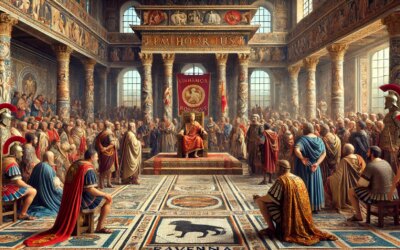
By the early 5th century, the Western Roman Empire was a shadow of its former self, its territories fragmented and its central authority severely diminished. Emperors were often weak figures, overshadowed by powerful military commanders known as magistri militum, who effectively wielded political and military control. The young Emperor Valentinian III was no exception, ruling under the regency of his formidable mother, Galla Placidia. This period saw a desperate need for strong leadership to counter barbarian incursions, yet the vacuum of power often led to internal rivalries among those best equipped to defend Rome.
The Rise of Powerful Generals
Flavius Aetius, a man with considerable experience among the Huns (having spent time as a hostage), had risen through the ranks, demonstrating exceptional military acumen and political cunning. Bonifatius, on the other hand, had established himself as a dominant force in North Africa, a crucial breadbasket for the empire. Both men possessed loyal armies and considerable influence, making them indispensable, yet also dangerous, to the imperial court. Their contrasting backgrounds and spheres of influence set the stage for an inevitable collision.
The Rivalry Ignites
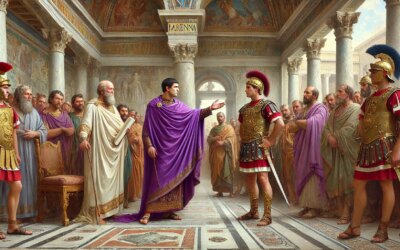
The rivalry between Aetius and Bonifatius was fueled by suspicion, ambition, and the machinations of the imperial court. Sources suggest that Aetius, already a powerful figure in Gaul, saw Bonifatius’s position in Africa as a threat to his own influence. Aetius allegedly manipulated Galla Placidia into recalling Bonifatius from Africa, simultaneously urging Bonifatius to defy the summons, portraying it as a plot against him. This clever deception led Bonifatius, who had previously been a loyal servant, to resist the imperial command, plunging North Africa into chaos and enabling the Vandals, already present in the region, to consolidate their gains.
Imperial Recall and Confrontation
Eventually, Galla Placidia realized the extent of Aetius’s cunning and sought to reconcile with Bonifatius. After a period of conflict and negotiation, Bonifatius returned to Italy in 432 AD, ostensibly to reclaim his loyalty and perhaps even challenge Aetius’s pre-eminence. The stage was set for a direct confrontation between the two most powerful generals of the dying Western Roman state, a clash that would determine who would guide the empire’s remaining years.
The Clash at Ravenna
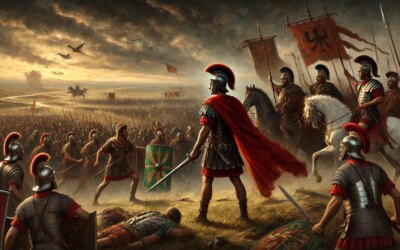
The armies of Aetius and Bonifatius met near the city of Ravenna, the capital of the Western Roman Empire at the time, in the autumn of 432 AD. This was not a battle against an external foe, but a devastating internal conflict that pitted Roman against Roman, led by generals who were ostensibly fighting for the same emperor. Details of the precise tactical maneuvers are scarce, but it is clear that both commanders led their forces personally, engaging in fierce combat.
A Fatal Encounter
During the intense fighting, Bonifatius, despite initial success, sustained a severe wound, reportedly from a spear thrown by Aetius himself. Though Bonifatius’s forces were victorious on the field, their leader succumbed to his injuries a few days later. This outcome effectively removed Aetius’s main rival, clearing his path to undisputed authority. The Battle of Ravenna of 432 AD, while a tactical victory for Bonifatius, became a strategic triumph for Aetius, ensuring his dominance over the Western Roman military for the next two decades.
Aftermath and Aetius’s Ascendancy
The death of Bonifatius left a void that Aetius quickly filled. Bonifatius’s son-in-law, Sebastianus, who had inherited some of his predecessor’s command, attempted to challenge Aetius but was ultimately outmaneuvered and forced into exile, eventually being executed. Aetius, now unchallenged, became the pre-eminent military commander of the Western Roman Empire. He would go on to be known as the ‘Last of the Romans’ for his efforts to preserve what remained of the empire against a multitude of barbarian threats, most notably his victory over Attila and the Huns at the Battle of the Catalaunian Plains in 451 AD.
Consolidation of Power
Aetius’s decades of influence following the Battle of Ravenna of 432 AD saw him skillfully navigate the complex political landscape, using a combination of military force, diplomacy, and strategic alliances to maintain a semblance of Roman control in Gaul and other provinces. His career highlights the tragic paradox of the late Western Empire: its most capable defenders were often locked in internecine struggles, weakening the state from within even as external enemies pressed in.
Frequently Asked Questions
Who were Flavius Aetius and Bonifatius?
Flavius Aetius and Bonifatius were two of the most powerful and capable Roman military commanders (magistri militum) in the Western Roman Empire during the early 5th century AD. They were rivals for influence and control over the empire’s dwindling resources and the young Emperor Valentinian III.
What was the significance of Ravenna in the 5th century AD?
Ravenna served as the capital of the Western Roman Empire from 402 AD, offering strategic advantages due to its coastal location and defensive marshes. It was the primary seat of imperial power and thus a crucial site for any contest of influence, such as the Battle of Ravenna of 432 AD.
What was the immediate outcome of the Battle of Ravenna of 432 AD?
Although Bonifatius’s forces initially won the day, he was mortally wounded during the Battle of Ravenna of 432 AD and died a few days later. This cleared the way for Flavius Aetius to become the undisputed military and political power in the Western Roman Empire for the next two decades.
How did Galla Placidia influence the events leading to the battle?
Galla Placidia, the mother and regent of Emperor Valentinian III, was initially manipulated by Aetius into issuing orders that isolated Bonifatius, leading to his perceived rebellion. Later, realizing her error, she attempted to reconcile with Bonifatius, contributing to the circumstances that brought the two generals to direct conflict at Ravenna.
What happened to Aetius after the Battle of Ravenna?
After his victory at the Battle of Ravenna in 432 AD, Aetius consolidated his power, eliminating Bonifatius’s allies and becoming the most influential figure in the Western Roman Empire. He spent the next two decades defending the empire against barbarian incursions, most famously defeating Attila the Hun at the Catalaunian Plains in 451 AD, before ultimately being assassinated by Emperor Valentinian III in 454 AD.