
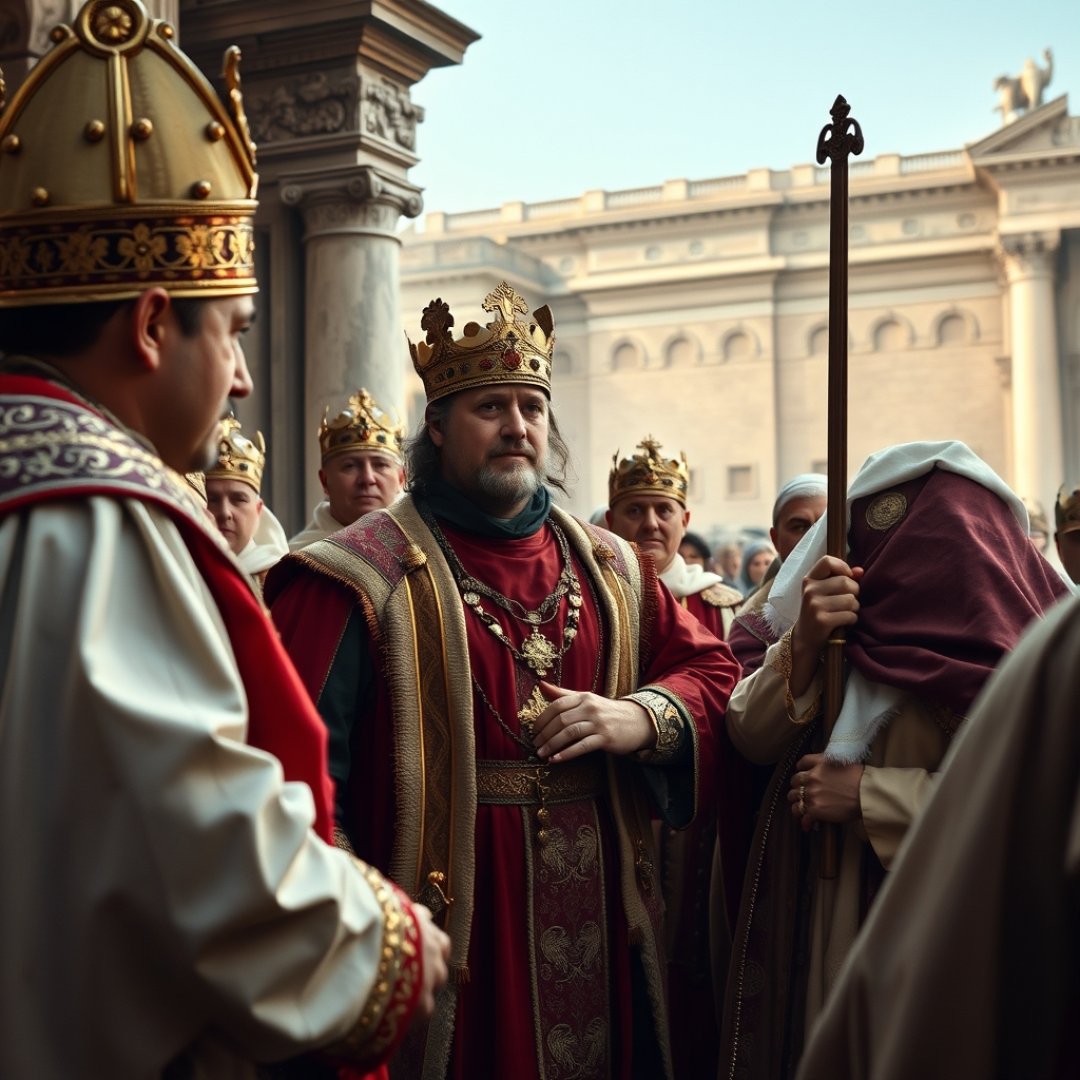
In the spring of 1014, a momentous event unfolded in the Eternal City: the solemn ceremony of Henry II’s Roman Coronation. This pivotal occasion saw Henry II, King of Germany and Italy, crowned Holy Roman Emperor by Pope Benedict VIII within the hallowed confines of St. Peter’s Basilica. His journey to Rome was not merely a ceremonial pilgrimage but a calculated assertion of imperial authority over an often-turbulent Italy, reflecting the enduring if complex relationship between the secular power of the emperor and the spiritual authority of the pope. The coronation symbolized a renewed, albeit fragile, alignment of German imperial ambitions with the papal desire for a strong protector against local Roman factions and external threats. It was a significant moment in the High Middle Ages, affirming the concept of a revived Roman Empire and setting a precedent for the delicate balance of power that would define European politics for centuries to come, underscoring Rome’s continued symbolic importance as the seat of both spiritual and imperial legitimacy.
The Journey to Imperial Crown: Henry II’s Aspirations
Henry II, a scion of the Ottonian dynasty, inherited the kingship of Germany in 1002 and was crowned King of Italy in Pavia in 1004. However, the ultimate prize—the imperial crown—awaited him in Rome, a title that conferred universal dominion and divine sanction. His predecessors, notably Otto I, had established the tradition of the German king receiving the imperial title from the Pope. By 1014, Henry’s position in Germany was largely secure, but Italy remained a complex patchwork of independent city-states, powerful noble families, and the ever-present influence of the Byzantine Empire in the south. His march south with a substantial army served dual purposes: to quell opposition in central and northern Italy, including rival claimants, and to secure his rightful claim to the imperial diadem, reinforcing the connection between the German crown and the legacy of the Roman Empire.
Establishing Authority in Italy
Before reaching Rome, Henry II spent considerable time reasserting imperial control across Italy. This involved:
- Suppressing revolts by local magnates who challenged his authority.
- Reaffirming his sovereignty over various northern Italian territories.
- Solidifying alliances with key figures and institutions, laying the groundwork for a more stable imperial presence.
These actions demonstrated Henry’s commitment to embodying the role of a true Roman Emperor, not just in name but in tangible governance and military strength, echoing the ancient Roman concept of effective dominion.
Pope Benedict VIII and the Sacred Ceremony
Pope Benedict VIII (born Theophylact II of Tusculum) was a powerful figure from a prominent Roman noble family. He had ascended to the papacy through considerable political maneuvering and military action, solidifying his control over Rome against rival factions. Recognizing the need for a strong imperial ally, Benedict VIII saw in Henry II a valuable protector against both the Crescentii family, who had previously dominated Roman politics, and the ongoing Saracen incursions into Italy. The mutual benefit of this alliance was evident: Henry gained the legitimacy of papal anointing, and Benedict secured a formidable defender of the Papal States and the Church’s interests. The coronation ceremony itself was a grand spectacle, steeped in ancient Roman and Christian traditions, signifying the transfer of divine authority and the binding of Church and Empire.
The Ritual of Coronation
The act of Henry II’s Roman Coronation followed a well-established liturgy:
- The Emperor-elect was received outside St. Peter’s Basilica.
- He made solemn oaths to protect the Roman Church.
- The Pope anointed him with holy oil, a symbol of divine grace.
- Finally, Benedict VIII placed the imperial crown upon Henry’s head, amidst acclamations from the Roman populace and clergy.
This ritual underscored the Pope’s role as the indispensable intermediary for bestowing the imperial title, a point of continuous contention between future emperors and the papacy.
Immediate Impact and Lasting Legacy
The Henry II’s Roman Coronation in 1014 had immediate and far-reaching consequences. For Henry, it solidified his claim to the Holy Roman Empire, elevating his status among European rulers. He subsequently issued various charters and decrees, demonstrating his imperial prerogative. For the Papacy, the coronation marked a period of strengthened collaboration with the Empire, at least temporarily, allowing Benedict VIII to pursue his own agenda, including military campaigns against the Saracens. However, the underlying tensions between imperial and papal supremacy, particularly over appointments and territorial control, remained unresolved and would resurface in future centuries. This event helped to re-establish the precedent of a strong, active Holy Roman Emperor as a dominant force in Italy and confirmed Rome as the symbolic heart where temporal and spiritual powers converged, shaping the political and religious landscape of the medieval world.
Challenges and Collaborations
Despite the grand ceremony, Henry II’s rule in Italy faced continuous challenges. He would return to Italy multiple times to assert his authority, battling local rebellions and engaging in diplomatic efforts. The relationship forged with Benedict VIII, while initially strong, illustrated the inherent difficulties in maintaining a stable balance between the two supreme powers of medieval Christendom. The coronation of 1014, therefore, was not an end to conflict but a significant milestone in the ongoing dialogue of power, influence, and the enduring legacy of Rome.
Frequently Asked Questions
Who was Henry II and what was his significance?
Henry II was a German king (from 1002) and Holy Roman Emperor (crowned in 1014). He was the last of the Ottonian dynasty and played a crucial role in reasserting imperial authority in Germany and Italy, strengthening the link between the German monarchy and the imperial title bestowed in Rome. He was later canonized as Saint Henry by the Catholic Church.
Why was Henry II’s Roman Coronation in 1014 important?
The coronation was important because it solidified Henry II’s claim to the prestigious title of Holy Roman Emperor, legitimizing his rule over a vast empire. It also underscored the vital role of the Pope in bestowing the imperial crown and highlighted Rome’s enduring symbolic importance as the historical capital of empire and the seat of the Church.
Who was Pope Benedict VIII at the time of the coronation?
Pope Benedict VIII, born Theophylact II, was a powerful Roman noble from the Tusculani family who served as Pope from 1012 to 1024. He was known for his strong political and military leadership, successfully consolidating papal power in Rome and leading campaigns against Saracen raids in southern Italy. His alliance with Henry II was mutually beneficial.
What was the political context in Italy and Rome around 1014?
Around 1014, Italy was politically fragmented, with various noble families, city-states, and regional powers vying for influence. The Papacy itself was often subject to the machinations of powerful Roman families. The presence of a strong Holy Roman Emperor like Henry II was often sought by popes to stabilize the region and counter both local rivals and external threats like the Saracens.
How did Henry II’s coronation influence the relationship between emperors and popes?
Henry II’s Roman Coronation reaffirmed the tradition of papal coronation for Holy Roman Emperors, reinforcing the idea that the Pope’s blessing was essential for imperial legitimacy. While it initially fostered cooperation between Emperor and Pope, it also subtly highlighted the inherent tension over who held ultimate authority – the secular ruler or the spiritual head of the Church – a conflict that would continue for centuries.
Related posts:
 The Investiture Controversy: Pope Gregory VII vs. Emperor Henry IV
The Coronation of Charlemagne: The Birth of the Holy Roman Empire
The Investiture Controversy: Pope Gregory VII vs. Emperor Henry IV
The Coronation of Charlemagne: The Birth of the Holy Roman Empire
 The Coronation of Otto III and Election of Pope Gregory V (996 AD): Reshaping Roman and Imperial Power
 Pope Gregory I and the Transformation of Rome in the 7th Century