
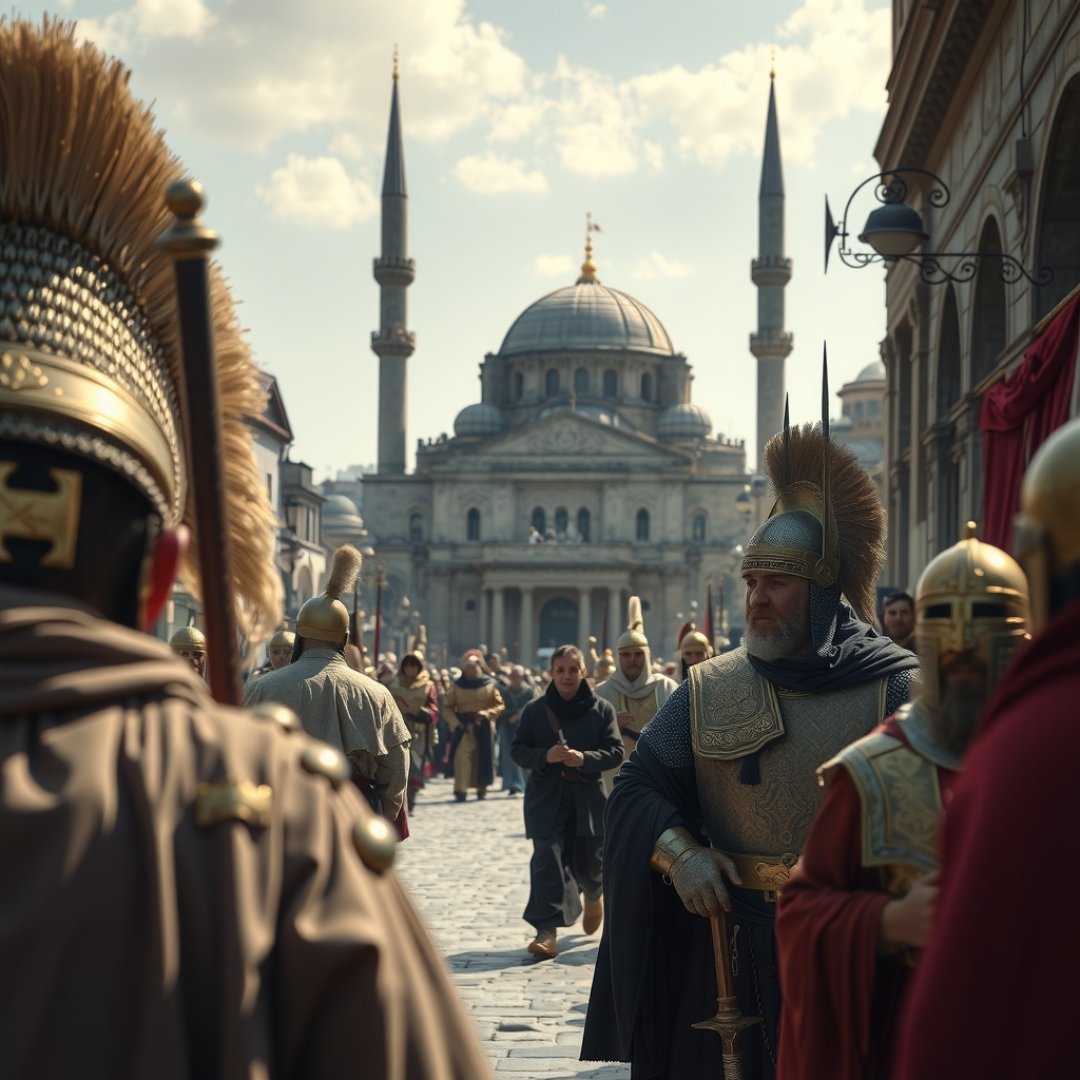
The year 1204 marks a profound rupture in the history of the Byzantine Empire and, by extension, the ongoing legacy of Roman power in the East. Instead of liberating the Holy Land, the knights and crusaders of the Fourth Crusade diverted their formidable forces to the ancient capital of Constantinople, sacking the city with unprecedented brutality. This catastrophic event did not merely plunder one of the world’s greatest cities; it fundamentally reshaped the political landscape, leading directly to the establishment of the Latin Empire of Constantinople. This new entity represented a bold, yet ultimately doomed, attempt by Western European feudal lords and the Roman Church to impose their authority and vision on a civilization that had for centuries maintained the traditions and imperial continuity of Rome in the East. Its creation, while a momentary triumph for the West, sowed seeds of division and resentment that would resonate for centuries and forever alter the relationship between East and West.
The Sack of Constantinople and the Imperial Partition (1204)
The fall of Constantinople on April 13, 1204, was a turning point. The crusaders, originally intent on an Egyptian campaign, were persuaded by Venetian Doge Enrico Dandolo to intervene in Byzantine imperial succession disputes. This intervention escalated into a full-scale assault on the city, culminating in its brutal sack. The looting lasted for days, with priceless relics, artworks, and treasures plundered and sent back to Western Europe. The Hagia Sophia itself was desecrated, its altar smashed, and its sacred objects stolen. Following the city’s capture, the victorious Western lords convened to divide the spoils and reorganize the conquered territories. This agreement, known as the Partitio Romaniae, formally dissolved the Byzantine Empire into a patchwork of feudal states, the largest of which was the newly proclaimed Latin Empire of Constantinople.
Governing the Latin Empire: Challenges and Feudal Structures
The newly established Latin Empire was envisioned as a feudal state, with a Latin emperor at its head, supported by a council of nobles and a Latin patriarch. Baldwin IX, Count of Flanders and Hainaut, was elected as the first Latin Emperor, Baldwin I. However, the empire faced immense challenges from its inception:
-
Lack of Resources and Manpower:
The crusaders who settled in Constantinople were far fewer in number than the indigenous Greek population and constantly struggled with financial and military shortages.
-
Greek Resistance:
The local Byzantine aristocracy and populace, outraged by the sack and the imposition of a foreign regime, quickly formed successor states in exile, such as the Empire of Nicaea, the Despotate of Epirus, and the Empire of Trebizond, all dedicated to reclaiming their ancestral capital.
-
Fragmented Authority:
The Latin Empire itself was carved into numerous lordships and fiefs, often leading to internal disputes and a lack of unified command against external threats.
-
Ecclesiastical Conflict:
The Latin Patriarchate, established in place of the Orthodox Patriarchate, was deeply unpopular with the Greek clergy and laity, exacerbating religious tensions.
These systemic weaknesses meant the Latin Empire was perpetually on the defensive, struggling to assert control beyond the immediate vicinity of Constantinople.
The Rise of Successor States and the Fall of Latin Rule
While the Latin Empire struggled, the Byzantine successor states thrived. The Empire of Nicaea, founded by Theodore Laskaris, emerged as the most formidable, establishing its capital in Nicaea (modern Iznik). The Nicaean emperors meticulously cultivated the Byzantine imperial legacy, portraying themselves as the rightful heirs to Rome and the liberators of their people. They built a strong army and patiently chipped away at Latin holdings in Anatolia and the Balkans. The other Greek states, Epirus and Trebizond, also maintained a fiercely independent stance, though Nicaea eventually became the dominant power aiming for reconquest.
The inevitable confrontation came in 1261. Under the brilliant generalship of Alexios Strategopoulos, the Nicaean forces, while campaigning near Constantinople, exploited a moment when the Latin garrison was absent. On July 25, 1261, the city was recaptured with minimal resistance. Emperor Michael VIII Palaiologos triumphantly entered Constantinople, ending the 57-year reign of the Latin Empire and effectively restoring the Byzantine Empire, albeit in a weakened and diminished form. The Latin Empire’s collapse marked the ultimate failure of a Western crusader project to permanently annex the Eastern Roman world.
Frequently Asked Questions
What was the primary reason for the creation of the Latin Empire of Constantinople?
The Latin Empire of Constantinople was created following the Fourth Crusade’s sack of the city in 1204. The crusaders and Venetians, after conquering Constantinople, decided to divide the Byzantine Empire’s territories and establish a new Western European feudal state in its place.
How long did the Latin Empire of Constantinople last?
The Latin Empire of Constantinople lasted for 57 years, from its establishment in 1204 until its reconquest by the Byzantine Empire of Nicaea in 1261.
Who was the first Latin Emperor of Constantinople?
Baldwin IX, Count of Flanders and Hainaut, was elected as the first Latin Emperor of Constantinople, becoming Baldwin I. He reigned from 1204 until his capture and presumed death in 1205 by the Bulgarians.
What were the main challenges faced by the Latin Empire?
The Latin Empire faced numerous challenges, including a severe lack of resources and manpower, constant resistance from the Greek population and exiled Byzantine successor states (like the Empire of Nicaea), internal feudal disputes, and deep religious conflict with the Orthodox Church and its adherents.
How did the Latin Empire ultimately fall?
The Latin Empire fell when forces from the Byzantine Empire of Nicaea, led by General Alexios Strategopoulos, recaptured Constantinople on July 25, 1261, restoring Byzantine rule under Emperor Michael VIII Palaiologos.
Related posts:
 The Sack of Constantinople (1204): The Fourth Crusade’s Darkest Hour
 The Council of Clermont of 1095: Pope Urban II’s Crusade Call to Arms
 The Siege of Constantinople (717–718 AD): Byzantium’s Stand Against the Caliphate
 Narses’ Italian Administration (c. 555 AD): Rebuilding Byzantine Italy After the Gothic War