
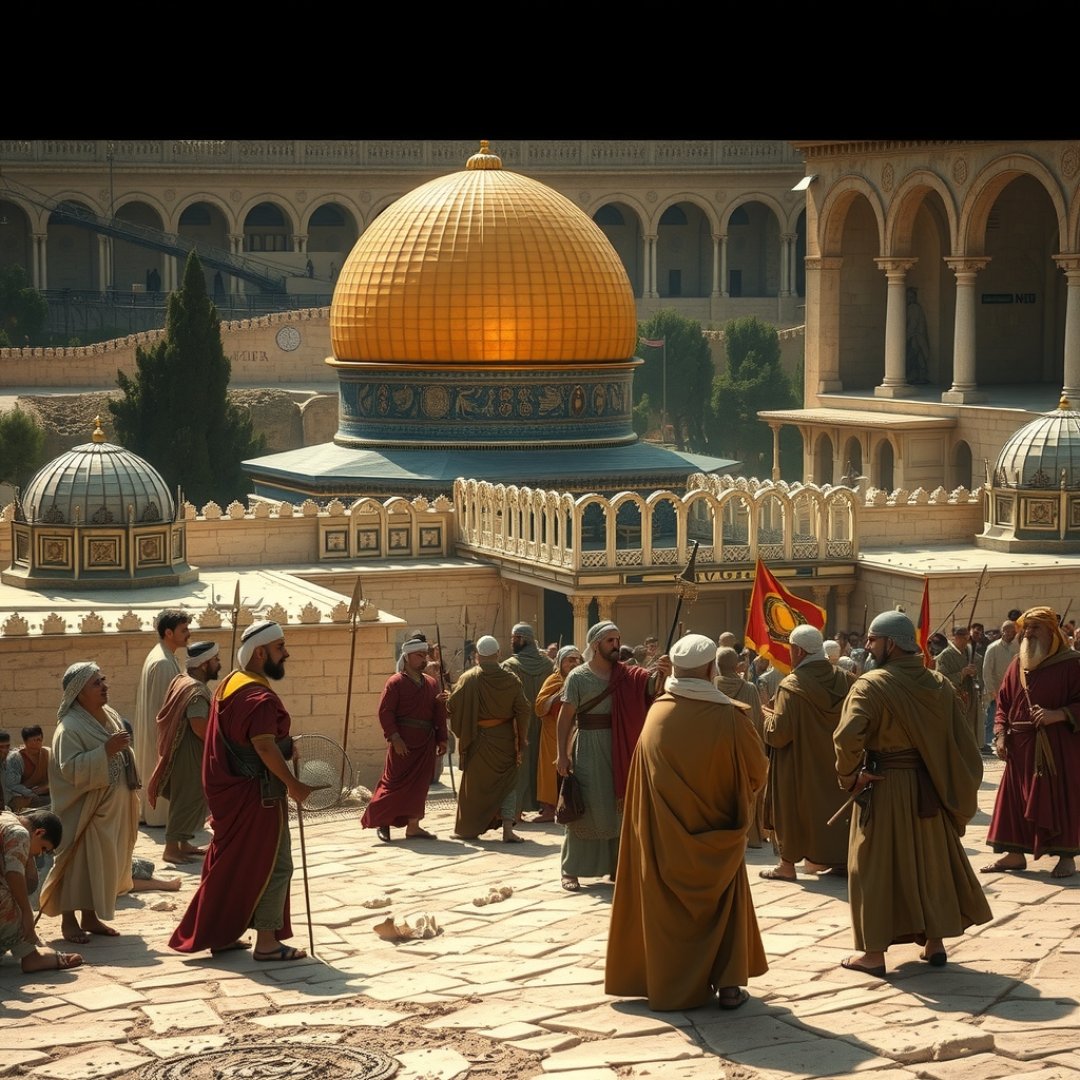
In the tumultuous early 7th century, as the Eastern Roman, or Byzantine, Empire grappled with internal strife and a new emperor, Heraclius, a formidable external threat loomed large: the Sasanian Persian Empire. This period saw the Byzantine state facing one of its most existential crises, with vast territories lost to a resurgent Persian foe. Among the most devastating blows suffered by Byzantium during this protracted conflict was the Sasanian Capture of Jerusalem in AD 614. This event was not merely a military defeat; it represented a profound symbolic and religious catastrophe for the Christian empire, shaking its very foundations and demonstrating the extent of Persian ascendancy in the Near East. The loss of the Holy City, with its sacred relics and deep spiritual significance, ignited a desperate resolve within the Byzantines, setting the stage for a dramatic imperial struggle for survival and reclamation.
The Escalation of the Byzantine-Sasanian War
The conflict that led to the Sasanian Capture of Jerusalem had its roots in the deposition and murder of Emperor Maurice by Phocas in AD 602. Khosrow II, the Sasanian Shahanshah, used Maurice’s death—who he claimed as his friend and benefactor—as a pretext to launch a full-scale invasion of the Byzantine Empire. What began as a punitive expedition quickly transformed into a war of conquest, with Persian forces systematically overwhelming Byzantine defenses across the Levant and Anatolia. By the second decade of the 7th century, the Sasanian armies, under capable generals like Shahrbaraz, had captured key cities such as Antioch and Damascus, demonstrating a military might not seen since the days of the Achaemenids. The Byzantine Empire, weakened by internal dissent and the incompetence of Phocas’s reign, was ill-prepared to stem the tide, paving the way for further Persian advances into vital Christian territories.
The Siege and Fall of the Holy City in AD 614
With much of Syria already under Sasanian control, Jerusalem became the next primary target. In the spring of AD 614, the Persian general Shahrbaraz led his army to besiege the city. The Christian inhabitants of Jerusalem, including its Jewish community who initially supported the Persians, bravely resisted for twenty-one days. However, starvation and the relentless Persian assault eventually led to the city’s capitulation. Contemporary accounts describe a brutal aftermath: thousands of inhabitants were massacred, many churches were destroyed or desecrated, and countless Christians were taken captive. The most significant loss, however, was the revered relic of the True Cross, believed to be the cross upon which Jesus Christ was crucified. It was seized by the Persians and carried off to Ctesiphon, the Sasanian capital, a devastating blow to Christian morale throughout the Byzantine world.
The Fate of the Inhabitants and Sacred Sites
Upon entering the city, the Sasanian forces, allegedly aided by local Jewish militias, engaged in widespread destruction. The Church of the Holy Sepulchre, a paramount Christian shrine, was severely damaged, along with numerous other holy sites. The number of dead and enslaved varied in historical accounts, but they consistently paint a picture of immense suffering and loss. The symbolic significance of Jerusalem as the cradle of Christianity meant that its fall sent shockwaves throughout the Christian world, amplifying the dire situation of the Byzantine Empire.
Long-Term Repercussions and Heraclius’s Resurgence
The Sasanian Capture of Jerusalem in AD 614 marked a nadir for the Byzantine Empire. Strategically, it solidified Persian control over the Levant and brought them closer to Egypt, the empire’s breadbasket. Symbolically and religiously, the loss of the True Cross and the devastation of Jerusalem was a powerful propaganda victory for the Sasanians and a profound humiliation for Byzantium. This catastrophe, however, also served as a catalyst for Emperor Heraclius, who had just consolidated his power after overthrowing Phocas. The loss of such a vital spiritual center galvanized Heraclius and his people, fueling a desperate desire for vengeance and reclamation. Over the next decade, Heraclius embarked on a series of daring campaigns, transforming the war into a holy crusade to recover the lost territories and, crucially, the True Cross. His eventual victories would culminate in the dramatic return of the relic to Jerusalem, but the events of 614 would forever underscore the vulnerability of the empire and the profound impact of religious symbolism on the course of war.
Frequently Asked Questions
What was the immediate cause of the Byzantine-Sasanian War that led to Jerusalem’s capture?
The war escalated significantly after Khosrow II, the Sasanian Shahanshah, used the murder of Emperor Maurice by the usurper Phocas in AD 602 as a casus belli to invade Byzantine territory, claiming to avenge his ‘friend’ Maurice.
Who was the Sasanian general responsible for the Sasanian Capture of Jerusalem?
The Sasanian forces that besieged and captured Jerusalem in AD 614 were led by the renowned general Shahrbaraz, one of Khosrow II’s most formidable commanders.
What happened to the True Cross after the fall of Jerusalem?
Following the Sasanian Capture of Jerusalem, the venerated relic of the True Cross was seized by the Persians and transported to their capital city of Ctesiphon as a trophy.
How did Emperor Heraclius eventually respond to the loss of Jerusalem and the True Cross?
Emperor Heraclius, having stabilized his rule, launched a series of brilliant counter-offensives against the Sasanian Empire, which culminated in the defeat of the Persians and the recovery of the True Cross, which he personally returned to Jerusalem in AD 630.
Related posts:
 Heraclius’s Persian Campaign of 622 AD: Reclaiming the East for Byzantium
 The Siege of Chalcedon in 617 AD: Persia’s Encirclement of Constantinople
 Emperor Heraclius’s Seizure of Church Wealth (c. 621 AD): Funding the Byzantine-Sasanian War
 The Battle of Ajnadayn of 634 AD: The Byzantine Collapse in Syria