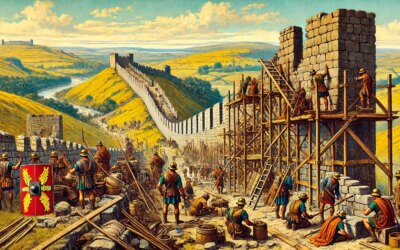
In AD 142, under the command of Emperor Antoninus Pius, the Roman Empire embarked on an ambitious undertaking in its northernmost province: the Antonine Wall construction. This colossal project aimed to establish a new defensive frontier across what is now central Scotland, stretching approximately 39 Roman miles from the Firth of Forth to the Firth of Clyde. Representing a strategic push beyond Hadrian’s Wall, the Antonine Wall was a testament to Roman engineering prowess and their persistent, if ultimately temporary, ambition to control the wild Caledonian lands. This turf and timber barrier, accompanied by a deep ditch and numerous forts, was more than just a military line; it was a bold statement of imperial authority and a significant chapter in Rome’s presence in Britain, marking a period of expansion that would prove to be both costly and fleeting.
The Strategic Shift: Why a New Frontier?
The decision to initiate the Antonine Wall construction represented a distinct shift in Roman frontier policy in Britain. For two decades, Hadrian’s Wall had served as the primary barrier, but under Antoninus Pius, Rome sought to consolidate its grip on southern Scotland and push the troublesome Caledonian tribes further north. While the precise motivations remain debated among historians, it is widely believed that the move was influenced by:
- Military ambition: A desire to re-assert Roman dominance and potentially exploit resources in the newly secured territories.
- Trouble in the north: Persistent unrest and incursions from tribes like the Brigantes and other northern groups, making Hadrian’s Wall an insufficient deterrent.
- Imperial prestige: A new emperor often sought to leave his mark through significant military or building projects, and expanding the empire’s reach was a classic demonstration of power.
The new frontier aimed to enclose the fertile lowlands between the two firths, creating a more manageable defensive line and projecting an image of strength to both the native Britons and the wider empire.
Engineering the Turf and Timber Barrier
Unlike its stone-built predecessor, the Antonine Wall construction primarily utilized turf and timber, making it a different, though equally impressive, engineering feat. The construction was carried out by legionaries from Legions II Augusta, VI Victrix, and XX Valeria Victrix, as evidenced by surviving distance slabs.
Design and Features
The wall consisted of a turf rampart, typically about 3 meters (10 feet) high and 4 meters (13 feet) wide at its base, built upon a stone foundation. To the north, a formidable ditch, approximately 5 meters (16 feet) deep and 12 meters (39 feet) wide, was excavated, further enhancing its defensive capabilities.
- Forts: Approximately 19 forts were built along the wall, housing garrisons at regular intervals.
- Fortlets and Signal Stations: Smaller outposts and signal towers provided additional surveillance and communication points.
- The Military Way: A service road running behind the wall facilitated troop movements and supply logistics.
The choice of materials allowed for quicker construction but necessitated more frequent maintenance compared to Hadrian’s Wall.
Life and Legacy on the Antonine Frontier
Life along the Antonine Wall was a unique blend of military duty and interaction with the local populace. Soldiers stationed here were drawn from across the vast Roman Empire, bringing diverse cultures to this remote northern outpost. The Wall’s purpose was not merely defensive; it also served as a control point for movement and trade, though its primary function remained military.
Abandonment and Reoccupation
Despite the significant effort put into its creation, the Antonine Wall construction proved to be a relatively short-lived frontier. Within two decades of its completion, around AD 162-164, the Romans began a phased withdrawal back to Hadrian’s Wall, which was re-garrisoned. There were brief reoccupations and repairs in later periods, notably under Septimius Severus in the early 3rd century, but the wall never again served as Rome’s enduring northern limit. Its abandonment likely stemmed from the immense cost of maintaining such a distant and exposed position, coupled with renewed pressures from northern tribes and strategic decisions made by later emperors. Today, the remnants of the Antonine Wall are a UNESCO World Heritage Site, offering a tangible link to Rome’s furthest reach.
Frequently Asked Questions
What was the Antonine Wall?
The Antonine Wall was a Roman defensive fortification made primarily of turf and timber, stretching across central Scotland from the Firth of Forth to the Firth of Clyde. It was built during the reign of Emperor Antoninus Pius in AD 142.
Why was the Antonine Wall built?
The wall was constructed to establish a new, more northerly frontier for Roman Britain, aiming to consolidate Roman control over southern Scotland and push back native tribes like the Caledonians, who often raided Roman territories. It also served as a display of imperial power under Antoninus Pius.
How long was the Antonine Wall in use?
The Antonine Wall was actively garrisoned and maintained for a relatively short period, primarily from its completion around AD 142 until its initial abandonment in AD 162–164. There were brief reoccupations, but it never became a long-term frontier like Hadrian’s Wall.
What remains of the Antonine Wall today?
Today, sections of the Antonine Wall, its ditch, and some fort remains can still be seen across central Scotland. It is a UNESCO World Heritage Site, with several visible archaeological sites, museums, and interpretive centers dedicated to its history and preservation.