
The year 376 AD marked a pivotal moment in the history of the Roman Empire, a year when the desperate pleas of a vast Gothic population seeking refuge across the Danube turned into a full-blown humanitarian crisis, exacerbated by stunning Roman mismanagement. Emperor Valens had granted the Tervingi Goths permission to settle in Thrace, hoping to integrate them and bolster his army. However, this seemingly strategic decision was tragically undermined by the corruption and cruelty of provincial officials, primarily the Dux Thracum Lupicinus and the military commander Maximus. Their systematic exploitation, starvation, and enslavement of the Goths, who were already vulnerable, became the tinderbox that ignited one of the most devastating conflicts the Empire had ever faced. The egregious abuses of Lupicinus and Maximus did not merely spark a localized rebellion; they set in motion a chain of events that would culminate in the catastrophic Battle of Adrianople and forever redefine the relationship between Rome and the ‘barbarian’ world, ultimately contributing to the eventual decline of the Western Roman Empire.
The Great Gothic Migration of 376 AD
In 376 AD, the Huns’ westward expansion pushed the Tervingi Goths, led by Fritigern and Alavivus, to the banks of the Danube. Faced with an existential threat, they sought refuge within the Roman Empire. Emperor Valens, then ruling the Eastern Roman Empire, saw an opportunity. He hoped to resettle the Goths in Thrace, converting them into a loyal source of recruits and taxpayers, thus strengthening his legions and bolstering the economy. The terms of their entry were theoretically straightforward: the Goths would lay down their arms, surrender their children as hostages, and be provided with land and provisions. However, the sheer scale of the migration – hundreds of thousands of people – quickly overwhelmed Roman logistical capabilities, setting the stage for disaster. It was in this chaos that unscrupulous Roman officials would find their chance for immense personal gain.
Lupicinus and Maximus: A Study in Corruption
As the Goths poured across the Danube, they fell under the authority of Roman provincial administrators, most notably Lupicinus, the military commander (dux) of Thrace, and a civilian governor named Maximus. These men, driven by avarice, saw the Goths not as future citizens or soldiers, but as a resource to be exploited. Instead of providing the promised food, they starved the Goths, forcing them to trade their few remaining possessions, their silver, and even their children into slavery for meager rations of dog meat. Historical accounts describe how Lupicinus intentionally kept the Goths segregated and deprived, fueling desperation and resentment. The widespread abuses of Lupicinus and Maximus created a powder keg, turning a potential ally into a simmering enemy.
The Seeds of Rebellion
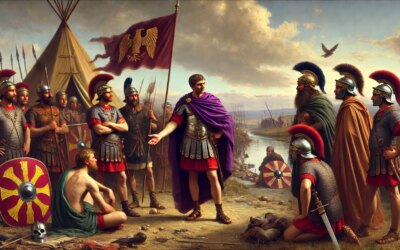
The Goths’ frustration grew with each passing day. With their people starving and their dignity stripped away, their leaders, Fritigern and Alavivus, eventually confronted Lupicinus. What was intended as a diplomatic meeting quickly escalated into a massacre. Lupicinus invited the Gothic leaders to a feast in Marcianople, only to attempt their assassination. Though Fritigern and Alavivus escaped, the betrayal solidified the Goths’ conviction that they could expect no justice or mercy from Roman authority. This event acted as a catalyst, transforming their desperation into open rebellion, and cementing the tragic role of the Roman officials’ misconduct.
The Inevitable Uprising and its Consequences
Once the Goths realized the extent of Roman treachery and the futility of peaceful coexistence, they erupted in revolt. The abuses of Lupicinus and Maximus had pushed them past their breaking point. What began as skirmishes for food quickly escalated into widespread pillaging and devastation across Thrace. Roman attempts to suppress the uprising were poorly coordinated and often met with disastrous results, highlighting the Empire’s weakness. The Battle of Marcianople, where Lupicinus’s hastily assembled forces were decisively routed, further emboldened the Goths. The rebellion grew, attracting other discontented ‘barbarian’ groups and even Roman slaves, transforming a localized grievance into a full-scale war that would consume the Eastern Empire for years. This series of events directly paved the way for the catastrophic Battle of Adrianople in 378 AD, a battle from which the Roman Empire would never truly recover.
A Legacy of Mistrust and Instability
The immediate consequence of the abuses of Lupicinus and Maximus was the loss of control over a massive, armed Gothic population within Roman territory. This led to devastating wars, culminated in Valens’ death at Adrianople, and ultimately forced Rome to adopt new, often less favorable, policies towards ‘barbarian’ groups. Instead of integrating them, Rome found itself frequently battling or reluctantly accommodating them as autonomous entities within its borders. The period following 376 AD saw a marked increase in the presence and influence of Germanic peoples within the Empire, often with profound long-term consequences for the integrity and ultimate survival of the Western Roman Empire. The story of Lupicinus and Maximus serves as a stark reminder of how individual corruption and short-sightedness can have monumental historical repercussions.
Frequently Asked Questions
Who were Lupicinus and Maximus?
Lupicinus was the Dux Thracum (military commander of Thrace) and Maximus was a civilian governor, both Roman officials responsible for administering the Gothic refugees who crossed the Danube into Roman territory in 376 AD.
What were the immediate consequences of their actions?
Their severe exploitation and starvation of the Goths led to widespread discontent, which erupted into open rebellion. This immediately destabilized the region of Thrace and initiated the Gothic War, a major conflict for the Eastern Roman Empire.
How did their abuses contribute to the Gothic War?
The corruption, starvation tactics, and an attempted assassination of Gothic leaders at Marcianople by Lupicinus and Maximus destroyed any trust between the Goths and Rome, leaving the Goths no option but to fight for their survival, thus directly sparking the war.
What was the broader impact of the abuses of Lupicinus?
The abuses of Lupicinus and Maximus directly led to the Battle of Adrianople in 378 AD, where Emperor Valens was killed and a significant portion of the Eastern Roman army was annihilated. This event fundamentally altered Rome’s military and political landscape, accelerating the decline of the Western Roman Empire.