
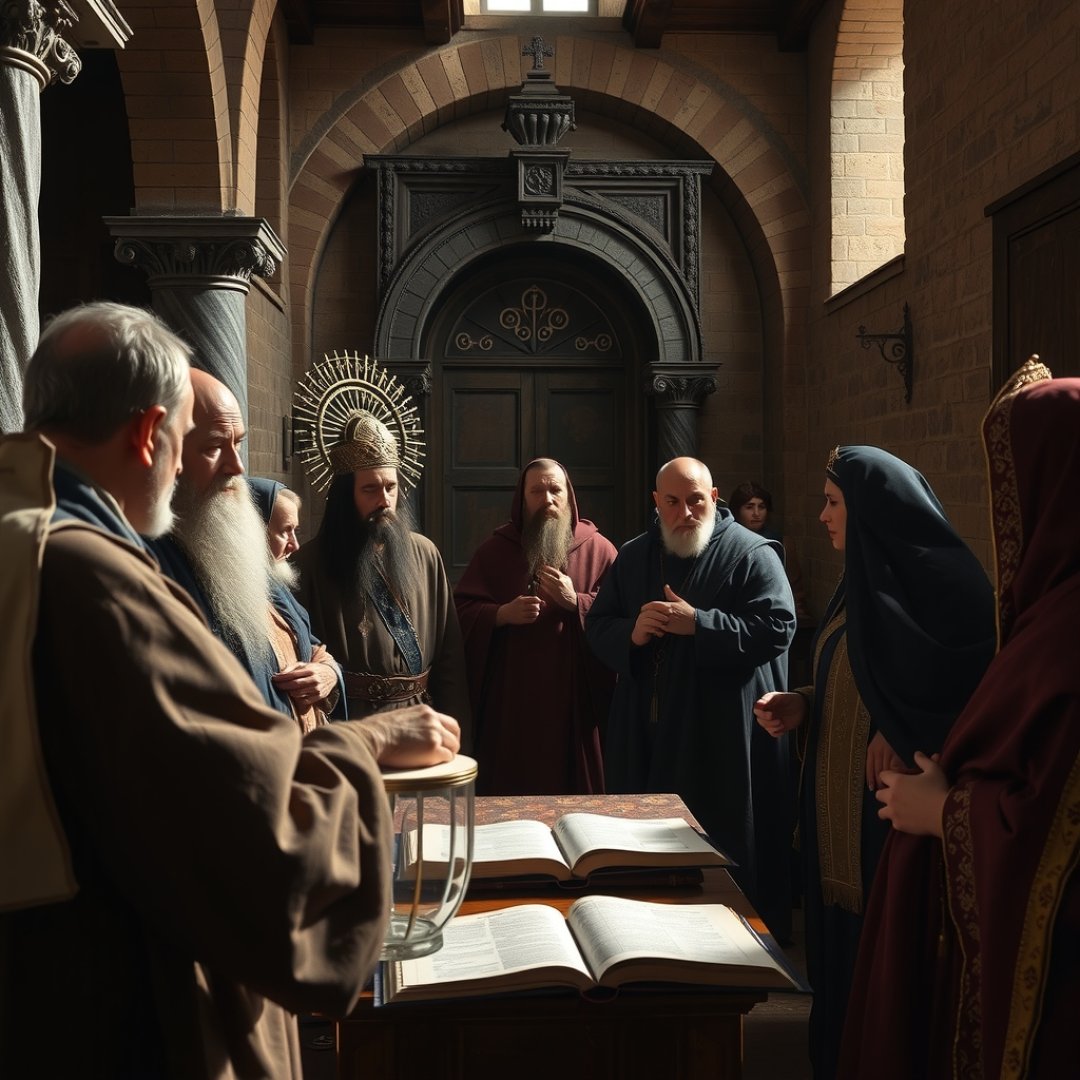
In the waning years of the Byzantine Empire, facing relentless Ottoman expansion, the Eastern Roman Emperor John VIII Palaiologos undertook a monumental journey to the West. This was not a military expedition, but a desperate diplomatic and theological mission to secure military aid from Catholic Europe. The culmination of these efforts was the convocation of the Council of Florence in 1439, a pivotal ecumenical council aimed at achieving a long-sought Byzantine Church Union with the Roman Catholic Church. This event, born of sheer necessity rather than a pure theological consensus, saw the gathering of prominent figures from both East and West, including the emperor himself, Patriarch Joseph II of Constantinople, and Pope Eugene IV. The discussions were fraught with centuries of doctrinal, liturgical, and political disagreements, yet the looming threat to Constantinople provided a powerful, albeit fragile, impetus for reconciliation. The stakes were incredibly high, as the survival of the last vestiges of the Roman Empire in the East hinged on the possibility of a united Christian front against an overwhelming common enemy.
The Context of Crisis: Byzantium on the Brink
By the early 15th century, the Byzantine Empire, once the glorious Eastern Roman Empire, had dwindled to little more than the city of Constantinople and a few scattered territories. The Ottoman Turks had steadily encroached upon its lands, isolating the capital and threatening its very existence. The appeals for Western military aid had largely gone unanswered since the disastrous Fourth Crusade in 1204, which had seen Constantinople sacked by Latin Christians. Despite this deep-seated mistrust, the immediate existential threat compelled Emperor John VIII Palaiologos to explore any avenue that might bring salvation.
Why Western Aid Was Crucial
- Military Superiority: The Ottoman Empire possessed a formidable army and navy, far outmatching Byzantium’s dwindling forces.
- Economic Weakness: Constantinople’s economy was in ruins, unable to fund a sustained defense.
- Geopolitical Isolation: Byzantium found itself increasingly alone, with traditional allies either weakened or pursuing their own interests.
The notion of a Byzantine Church Union was seen as the most potent bargaining chip to rally Catholic Europe to its cause. It was a recognition that theological unity might unlock the political and military support desperately needed to stave off imperial collapse.
The Journey to Florence and the Road to Union
Emperor John VIII, accompanied by a substantial delegation of Byzantine clergy, scholars, and officials, including the influential Neoplatonist philosopher Gemistus Pletho and Bessarion of Nicaea, embarked for Italy in 1438. They first convened in Ferrara before moving to Florence due to an outbreak of plague. The council was arduous, lasting over a year, with intense debates over fundamental theological differences such as the Filioque clause (the procession of the Holy Spirit), purgatory, papal primacy, and the use of leavened or unleavened bread in the Eucharist.
Key Figures and Their Roles
The council saw a clash of intellectual titans and deeply held beliefs:
- Emperor John VIII Palaiologos: The pragmatic leader, keenly aware of the political imperative.
- Pope Eugene IV: The Roman pontiff, eager to assert papal authority and heal the Great Schism.
- Patriarch Joseph II of Constantinople: The spiritual head of the Eastern Church, who tragically died during the council, adding to the pressure.
- Cardinal Bessarion: A prominent Byzantine scholar who strongly advocated for union and later became a cardinal in the Latin Church.
- Mark of Ephesus: The staunchest opponent of union, who refused to sign the final decree.
Under immense pressure and political maneuvering, a decree of union, Laetentur Caeli (‘Let the Heavens Rejoice’), was eventually signed on July 6, 1439. This document proclaimed the reconciliation of the Churches, seemingly achieving the long-sought Byzantine Church Union.
The Aftermath: A Union Unaccepted
Despite the formal agreement in Florence, the union proved to be largely a paper victory. Upon the return of the Byzantine delegation to Constantinople, the decree was met with widespread opposition from the clergy, monks, and the populace. Many viewed the concessions made to the Latin Church as a betrayal of Orthodox faith and traditions. The common refrain was, ‘Better the turban of the Sultan than the tiara of the Pope.’
The promised Western military aid materialized only partially and too late to prevent the inevitable. While a small crusade led by Vladislaus III of Poland and Hungary was launched, it was decisively defeated by the Ottomans at Varna in 1444. The official proclamation of the union within Constantinople itself was delayed until December 12, 1452, just months before the city’s final siege.
Factors Contributing to the Union’s Failure
- Deep-Seated Theological Differences: Centuries of distinct doctrinal development could not be easily bridged by political necessity.
- Popular Resentment: The Byzantine populace and much of the lower clergy felt their traditions and identity were sacrificed.
- Lack of Tangible Aid: The limited and ultimately ineffective Western military response undermined the practical justification for the union.
- Influence of Anti-Union Factions: Figures like Mark of Ephesus successfully galvanized opposition.
The Council of Florence ultimately failed to achieve its primary objective of saving Constantinople through Byzantine Church Union, highlighting the profound chasm between the Eastern and Western Christian worlds that even existential threat could not fully overcome. It remains a poignant symbol of Byzantium’s final struggles.
Frequently Asked Questions
What was the main goal of the Council of Florence?
The primary goal of the Council of Florence in 1439 was to achieve a formal union between the Eastern Orthodox Church and the Roman Catholic Church. This was principally driven by the Byzantine Emperor John VIII Palaiologos’s desperate need for Western military aid to defend Constantinople against the encroaching Ottoman Turks.
Who were the key participants from the Byzantine side?
The Byzantine delegation was led by Emperor John VIII Palaiologos and included Patriarch Joseph II of Constantinople, numerous metropolitans and bishops, and influential scholars such as Cardinal Bessarion and Gemistus Pletho. Mark of Ephesus was also a prominent Byzantine figure, notable for his strong opposition to the union.
What were the main theological points of contention discussed at the Council?
The primary theological disagreements revolved around the Filioque clause (the addition of ‘and the Son’ to the Nicene Creed regarding the procession of the Holy Spirit), the nature of purgatory, the supremacy of the Pope as the head of the entire Christian Church, and the use of leavened versus unleavened bread in the Eucharist.
Was the union achieved at Florence accepted by the Byzantine people?
No, the union formally decreed at Florence was largely rejected by the Byzantine clergy and populace upon the delegation’s return to Constantinople. Many viewed it as a betrayal of Orthodox faith, and popular sentiment strongly opposed the concessions made to the Latin Church. This widespread rejection ultimately rendered the union ineffective.
What was the long-term impact of the Council of Florence?
While the Council of Florence failed to secure lasting Byzantine Church Union or significant Western military aid for Constantinople, it is a crucial event in church history. It highlighted the deep divisions between East and West, contributed to the intellectual exchange between Byzantine scholars and Western humanists, and provided a formal, albeit short-lived, document of union that continues to be studied in ecumenical dialogues.
Related posts:
 The Fall of Constantinople: Constantine XI’s Final Stand in 1453
 The Death of Pope Gregory I (604 AD): A Turning Point for the Early Medieval Papacy
 The Venetian Crisis of 809-810 AD: Pippin’s Failed Assault on Byzantine Venice
 The East-West Schism of 1054 AD: The Great Divide Between Roman and Eastern Christianity