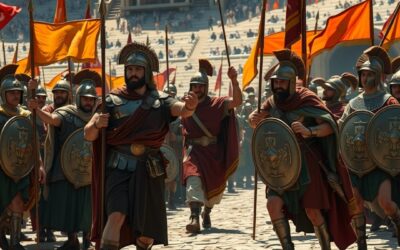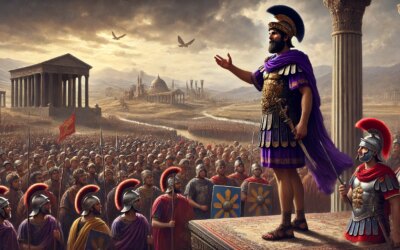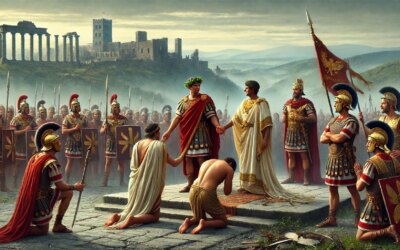
In the tumultuous mid-4th century AD, the Roman Empire faced myriad threats on its frontiers, particularly in the western provinces where barbarian incursions had become a relentless tide. It was into this volatile environment that Flavius Claudius Julianus, a young and initially unassuming cousin of Emperor Constantius II, was thrust into the role of Caesar of Gaul in 355 AD. Little did anyone know, this appointment would mark the beginning of a remarkable military and administrative career, but not without immediate and severe challenges. One of the earliest and most critical episodes that would define his resilience and strategic acumen occurred almost immediately upon his arrival: the harrowing Siege of Senonae in 356 AD. This engagement, often overshadowed by his later, more decisive victories, served as a profound baptism of fire, representing Julian’s Early Test in confronting the formidable Alamanni tribes. It was here, isolated and exposed, that Julian had to grapple with the harsh realities of frontier warfare, the complexities of military command, and the treachery that could lurk within his own ranks, setting a precedent for the intense struggles he would endure and ultimately overcome in his meteoric rise to imperial prominence.
Gaul on the Brink: A Caesar’s Unenviable Task
By the mid-4th century, the Roman provinces of Gaul were in a state of advanced disarray. Persistent raids by Germanic tribes, particularly the Alamanni and Franks, had devastated cities, depopulated rural areas, and severely disrupted trade and administration. Emperor Constantius II, preoccupied with threats in the East and unwilling to delegate substantial authority, had nonetheless been compelled to appoint a Caesar to restore order in the beleaguered West. His choice, Julian, was an unlikely one. Having survived the purge of his family that saw his father and elder brother executed, Julian had spent his early life under virtual house arrest, immersing himself in philosophy and scholarship. His lack of military experience made his appointment controversial, viewed by some as a calculated risk by Constantius II to dispose of a potential rival without direct confrontation. Julian’s arrival in Gaul in 355 AD, therefore, marked a turning point, as he inherited a fragmented command structure and a region desperate for leadership.
The Unexpected Onslaught at Senonae
In 356 AD, Julian embarked on his first active campaign season. After a brief stay in Vienna, he moved his forces north to confront the barbarian threat directly. While in the city of Senonae (modern Sens, France), an important Roman urban center in Gallia Lugdunensis, Julian found himself unexpectedly surrounded. A large contingent of Alamanni warriors, ever opportunistic, launched a swift siege, cutting off the city from external relief. This was Julian’s Early Test in its most immediate and visceral form. The situation was perilous: Julian, still a novice commander, was trapped with a relatively small retinue. The city’s defenses, while substantial, faced the relentless pressure of a determined barbarian force. Critically, the Roman general commanding the provincial troops, Marcellus, whose camp was not far distant, inexplicably failed to come to Julian’s aid. Whether this was due to incompetence, fear, or deliberate malice remains a subject of debate among historians, but its effect was to leave Julian isolated and vulnerable.
Julian’s Resilience Under Pressure
Despite the dire circumstances and the palpable lack of support from senior commanders, Julian demonstrated remarkable fortitude. He organized the city’s defense, rallied the garrison and citizens, and held out against the Alamanni for an entire month. His ability to maintain morale and effectively manage the limited resources within the besieged city showcased a natural talent for leadership that belied his academic background. The barbarians, unable to breach Senonae’s strong walls and likely frustrated by their inability to capture such a high-value target, eventually withdrew. While not a pitched battle victory, the successful defense of Senonae was a crucial moral triumph for Julian and for Roman authority in Gaul. It proved that despite the odds, and even in the face of internal betrayal, resistance against the barbarian tide was possible.
The Aftermath: Treachery and a Commander’s Growth
The lifting of the siege brought immediate relief but also exposed deep fissures within the Roman military command. The failure of General Marcellus to relieve Senonae was a glaring example of the infighting and distrust that plagued the Late Roman army. Julian, now acutely aware of the potential for internal sabotage, acted decisively. Marcellus was subsequently relieved of his command, though his punishment was lighter than many might have expected, largely due to the cautious political maneuvering of Constantius II, who likely did not wish to alienate powerful factions. For Julian, the Siege of Senonae was a formative experience. It forged his understanding of logistical challenges, the importance of reliable subordinates, and the psychological impact of prolonged siege warfare. This crucial period, immediately after his appointment, laid the groundwork for his subsequent, more celebrated campaigns, such as his decisive victory at Argentoratum (Strasbourg) in 357 AD. The lessons learned during Julian’s Early Test at Senonae undoubtedly contributed to his strategic development, transforming the philosopher-prince into a formidable military leader who would briefly reshape the destiny of the Roman Empire.
Frequently Asked Questions
What was the primary significance of the Siege of Senonae for Julian?
The Siege of Senonae served as Julian’s first major military challenge after being appointed Caesar of Gaul. It was a baptism of fire that tested his leadership, strategic thinking, and resilience under extreme pressure, demonstrating his inherent capacity for command despite his lack of prior military experience.
Who besieged Julian at Senonae in 356 AD?
Julian and the city of Senonae were besieged by a large force of Alamanni warriors, a confederation of Germanic tribes who frequently raided Roman Gaul during the 4th century AD.
Why was Julian’s position at Senonae particularly perilous?
Julian was a relatively inexperienced commander at the time, surrounded by a formidable barbarian force, and crucially, was not relieved by the Roman general Marcellus, who was stationed nearby. This left Julian isolated and vulnerable, facing not only external enemies but also potential internal disloyalty.
How long did the Siege of Senonae last?
Julian and the Roman garrison successfully defended Senonae against the Alamanni for approximately one month before the barbarian forces eventually withdrew.
What impact did the Siege of Senonae have on Julian’s later military career?
The lessons learned during the siege, particularly regarding the importance of reliable subordinates and effective defense, were crucial for Julian’s development. This early challenge helped shape him into the skilled military leader who would achieve significant victories against barbarian incursions in Gaul, most famously at Argentoratum a year later.