
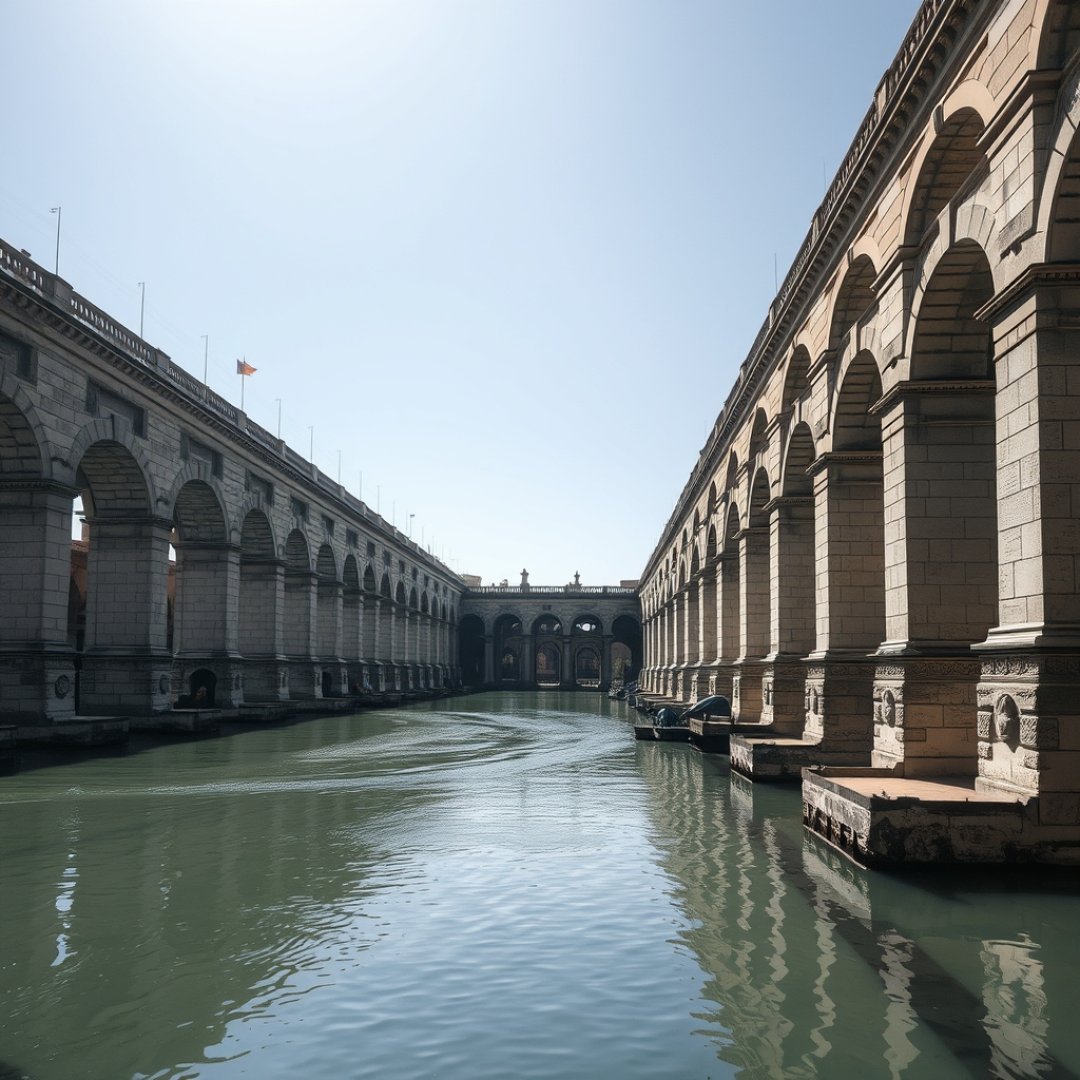
In the vibrant early 17th century, as Rome buzzed with Renaissance and burgeoning Baroque artistry, a critical infrastructure project began that would profoundly impact the city’s daily life: the Acqua Paola restoration. Initiated around 1607 by Pope Paul V, this ambitious undertaking was far more than a simple repair; it was a grand revival of an ancient Roman aqueduct, designed to supply fresh water to the burgeoning Trastevere district and the Vatican. Drawing upon the venerable Aqua Traiana, a testament to imperial Roman engineering, Paul V’s project blended historical reverence with contemporary needs, ensuring a sustainable water supply for a growing population. The completed aqueduct, culminating in the monumental Fontana dell’Acqua Paola on the Janiculum Hill, stands today not only as a functional marvel but also as an enduring symbol of papal patronage and the continuous thread of Roman ingenuity, connecting the glory of the ancient world with the splendor of the Baroque era.
The Ancient Precedent: Rome’s Legacy of Water
Rome’s mastery of water management was legendary, a hallmark of its engineering prowess. Among the numerous aqueducts built to supply the sprawling city, the Aqua Traiana stood out. Constructed by Emperor Trajan and inaugurated in AD 109, it channeled water from volcanic lakes in the Bracciano region, specifically Lake Bracciano and Lake Martignano, over 50 kilometers to the Janiculum Hill. This ancient lifeline was crucial for supplying the western districts of Rome, including Trastevere and the Vatican, nourishing baths, fountains, and private homes. However, like many of Rome’s ancient structures, the Aqua Traiana suffered damage and fell into disuse over centuries, especially after the Gothic Wars of the 6th century. By the Renaissance, its once-copious flow was a mere trickle, if present at all, leaving entire sections of the city parched and reliant on local wells or the Tiber.
The Decline of a Roman Marvel
The strategic importance of the Aqua Traiana was evident in its initial construction, utilizing gravity to bring pure spring water directly into the city. Its decline reflected the broader decay of Roman infrastructure in the post-imperial era. Over time, segments were broken by invaders, stone was plundered for other constructions, and maintenance ceased. Consequently, the areas it once served, particularly the vibrant but increasingly underserved Trastevere, faced significant challenges in accessing clean water. The lack of reliable potable water was not just an inconvenience; it posed serious public health risks and hindered urban development, a problem Pope Paul V keenly recognized upon his ascension to the papacy.
Pope Paul V’s Ambitious Vision for a Modern Rome
When Camillo Borghese ascended to the papacy as Paul V in 1605, Rome was a city undergoing a grand transformation, yet many districts, especially on the right bank of the Tiber, still lacked adequate water supply. The flourishing population and the ambitious urban development projects of the Renaissance and early Baroque demanded a more robust infrastructure. Paul V, recognizing the critical need and seeking to emulate the grand gestures of his imperial predecessors and recent popes like Sixtus V who revived the Acqua Felice, set his sights on the venerable Aqua Traiana. His vision was to restore this ancient conduit, not merely to its former glory but to adapt it for the needs of 17th-century Rome, ensuring a plentiful supply for the Vatican, the Trastevere district, and his own newly commissioned fountains.
Initiating the Restoration Project
The Acqua Paola restoration project began in earnest around 1607. Pope Paul V entrusted the monumental task to a team of architects and engineers, initially Giovanni Fontana and later his nephew Carlo Maderno, the same architect responsible for the façade of St. Peter’s Basilica. The work involved extensive surveys to locate the original springs, clear debris from the ancient channels, and rebuild damaged sections. This was no small feat; it required significant financial investment, skilled labor, and an intimate understanding of both ancient Roman engineering principles and contemporary construction techniques. The pope’s patronage was absolute, underscoring the political and symbolic importance of the project, which would literally bring life back to neglected parts of the Eternal City.
Engineering and Architectural Triumph: The Acqua Paola
The process of restoring the Aqua Traiana into what became known as the Acqua Paola (named in honor of Paul V, Paulus in Latin) was a complex blend of archaeological excavation and modern construction. Engineers had to:
- Identify and secure the original spring sources near Lake Bracciano.
- Clean and repair miles of subterranean and above-ground channels.
- Construct new sections where the ancient aqueduct was irrecoverable, often using contemporary building materials and methods.
- Ensure a consistent gradient for gravity-fed flow.
The efforts culminated in 1612 with the grand opening of the Fontana dell’Acqua Paola on the Janiculum Hill, directly overlooking the city. This magnificent fountain, designed by Giovanni Fontana and Carlo Maderno, was conceived as a triumphal arch, symbolizing the successful revival of Rome’s ancient hydraulic heritage. It featured six majestic arches (later reduced to three), from which water cascaded into a large basin, adorned with the Borghese coat of arms – a dragon and an eagle – celebrating the pope’s family and his monumental achievement.
Impact on Rome’s Urban Landscape
The successful completion of the Acqua Paola had an immediate and profound impact. For the first time in centuries, the western districts of Rome enjoyed a reliable and abundant supply of fresh drinking water. This vital resource not only improved public health and sanitation but also facilitated further urban development and beautification, enabling the creation of new gardens, private fountains, and public amenities. The Fontana dell’Acqua Paola itself became an iconic landmark, offering stunning panoramic views of Rome and serving as a powerful visual reminder of Pope Paul V’s commitment to the city’s welfare and his connection to the engineering brilliance of ancient Rome.
Frequently Asked Questions
What was the primary purpose of the Acqua Paola restoration?
The primary purpose of the Acqua Paola restoration was to revive the ancient Aqua Traiana aqueduct to supply fresh drinking water to the Trastevere district, the Vatican, and other western areas of Rome, which had suffered from a lack of reliable water for centuries.
Who was responsible for initiating the Acqua Paola project?
The Acqua Paola restoration was initiated by Pope Paul V, who reigned from 1605 to 1621. The aqueduct and its monumental fountain were named in his honor.
Which ancient Roman aqueduct did the Acqua Paola restore?
The Acqua Paola was a restoration and reconstruction of the ancient Aqua Traiana, originally built by Emperor Trajan and completed in AD 109, which drew water from Lake Bracciano.
Where is the famous Acqua Paola fountain located?
The magnificent Fontana dell’Acqua Paola, the monumental terminus of the aqueduct, is situated on the Janiculum Hill (Gianicolo) in Rome, offering panoramic views of the city.
How did the Acqua Paola project impact 17th-century Rome?
The Acqua Paola brought a reliable and abundant supply of fresh water to previously underserved districts, significantly improving public health, sanitation, and urban development, and contributing to the city’s Baroque beautification.
Related posts:
 The Domus Aurea: Nero’s Golden Palace and Its Controversial Legacy
 The Baroque Transformation of Rome: Bernini and the Construction of St. Peter’s Square
 The Construction of Hadrian’s Wall (122-128 AD): Rome’s Northern Frontier
 Caligula’s Baiae Pontoon Bridge (AD 39): An Emperor’s Eccentric Spectacle