
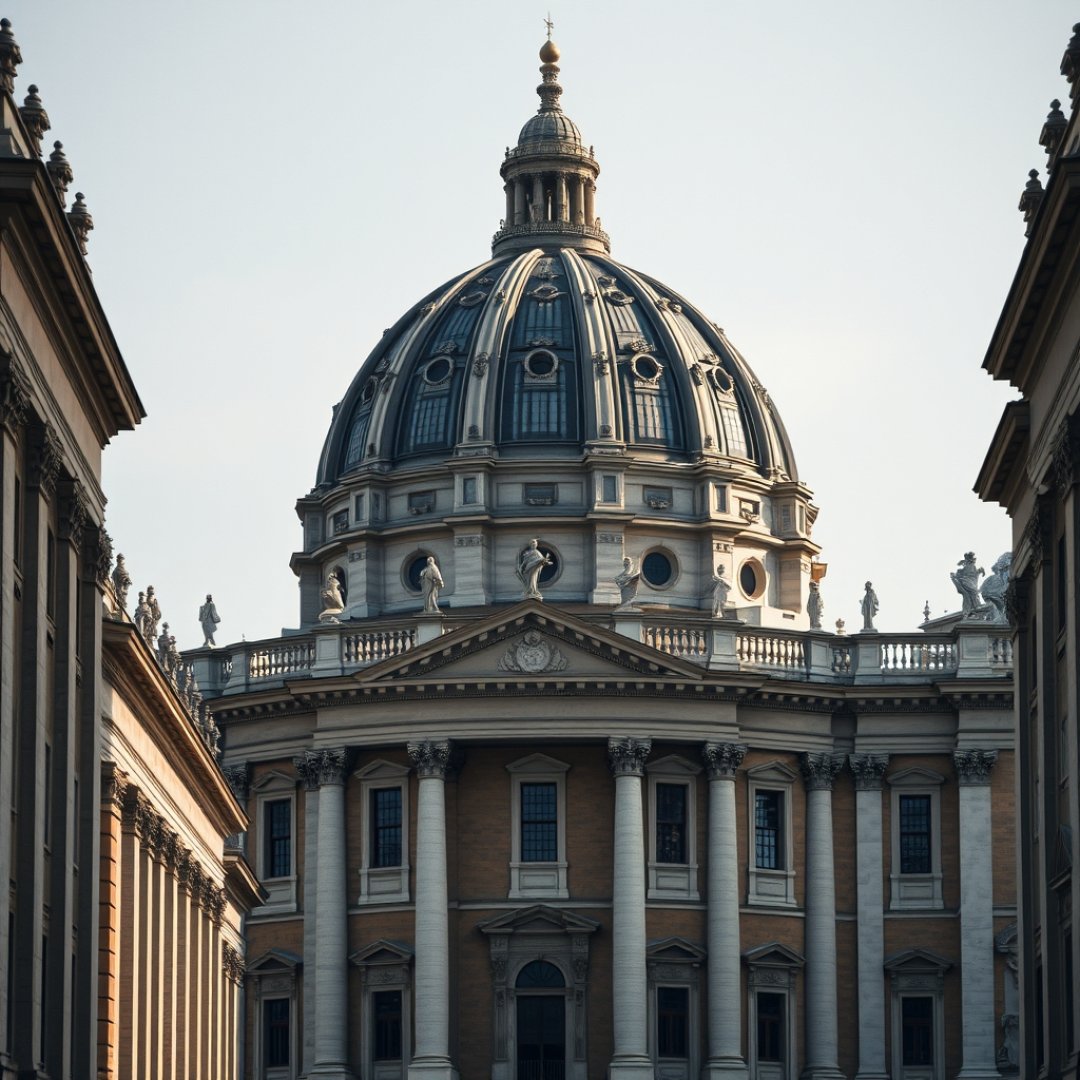
The skyline of Rome changed forever in 1590 with the monumental St. Peter’s Dome Completion. This crowning achievement of Renaissance architecture, a testament to centuries of ambition and ingenuity, marked a pivotal moment in the history of the Eternal City. Following the visionary designs initially conceived by Michelangelo, the final stages of the dome’s construction were overseen by skilled architects Giacomo della Porta and Domenico Fontana. More than just a structural marvel, the dome became a powerful symbol of papal authority and the Counter-Reformation’s resurgence. Its majestic presence dominates the Vatican, drawing the eye upwards and commanding respect, much as the ancient Roman Pantheon had once done. The completion solidified Rome’s place as a center of artistic and engineering excellence, demonstrating the enduring legacy of classical Roman principles translated into a new, grand Christian context. This article delves into the intricate process, the key figures, and the lasting impact of this architectural wonder that continues to inspire awe.
Michelangelo’s Grand Vision for St. Peter’s Dome
The story of St. Peter’s Basilica’s dome begins long before its eventual St. Peter’s Dome Completion in 1590, rooted deeply in the artistic and architectural genius of Michelangelo Buonarroti. Appointed chief architect of St. Peter’s in 1546, Michelangelo inherited a project that had seen numerous master builders and shifting designs. Dissatisfied with previous models, he boldly returned to Bramante’s original Greek-cross plan and conceived a magnificent double-shelled dome, drawing inspiration from Brunelleschi’s dome of Florence Cathedral and his own profound understanding of ancient Roman structures like the Pantheon. Michelangelo’s design, however, was characterized by an unprecedented sense of monumental grandeur and dynamic tension, featuring robust buttresses and a soaring profile. Crucially, he completed the drum – the circular base upon which the dome would rest – before his death in 1564. This ensured that the structural foundation and much of the aesthetic direction for the dome were firmly established, providing a clear blueprint for his successors.
The Collaborative Effort: Della Porta and Fontana’s Execution
After Michelangelo’s death, the formidable task of realizing his vision for the dome fell to Giacomo della Porta and Domenico Fontana. Despite the challenges posed by the sheer scale and technical complexity of the project, they adhered remarkably closely to Michelangelo’s original plans, albeit with some notable modifications.
Architectural Finesse and Engineering Ingenuity
Della Porta, taking over in 1573, was responsible for the crucial decision to heighten the dome’s profile slightly, giving it a more pointed and ethereal appearance than Michelangelo’s flatter model. This subtle alteration added to its soaring quality, enhancing its visual impact from a distance. The actual construction required innovative engineering techniques, as the vast weight of the dome had to be supported by the drum below.
- Giacomo della Porta: Main architect responsible for the final design adjustments and significant construction phases.
- Domenico Fontana: Highly skilled engineer and architect, brought in by Pope Sixtus V, who managed the intricate scaffolding and lifting operations for the final lantern.
The work progressed with remarkable speed, particularly under the patronage of Pope Sixtus V (reigned 1585–1590), who prioritized the dome’s completion. Fontana’s expertise in hoisting immense loads, honed during the relocation of the Vatican Obelisk, proved invaluable in the final stages, especially for the placement of the lantern and cupola.
The Enduring Legacy of the Vatican’s Crown Jewel
The St. Peter’s Dome Completion in 1590 was not merely an architectural milestone; it was a profound declaration of power, faith, and artistic mastery. Its finished form, soaring over Rome, instantly became the most recognizable symbol of the city and the Catholic Church.
A Beacon of the Counter-Reformation
In an era marked by religious upheaval and the Protestant Reformation, the dome served as a tangible expression of Catholic triumph and resilience. It projected an image of stability and divine favor, reinforcing Rome’s status as the spiritual heart of Western Christendom. Architecturally, it set new standards for monumental construction and influenced countless subsequent domed structures across Europe, from St. Paul’s Cathedral in London to the Capitol Building in Washington D.C. The techniques and innovations developed during its construction demonstrated the continuous evolution of Roman engineering principles, bridging the ancient and modern worlds. Even today, entering St. Peter’s Basilica and gazing up into the vast, luminous expanse of the dome is an overwhelming experience, a testament to the enduring vision of Michelangelo and the skilled hands that brought it to life.
Frequently Asked Questions
Who was the primary designer of St. Peter’s Dome?
The initial and most influential design for St. Peter’s Dome was conceived by Michelangelo Buonarroti. His plans for the drum and the overall double-shell structure laid the foundational blueprint.
When was the dome of St. Peter’s Basilica completed?
The main structure of St. Peter’s Dome was largely completed in 1590, with the final lantern and cupola put in place by Giacomo della Porta and Domenico Fontana.
What makes St. Peter’s Dome architecturally significant?
St. Peter’s Dome is significant for its immense scale, its innovative double-shell construction, and its synthesis of classical Roman and Renaissance architectural principles. Its soaring profile and intricate internal structure set a benchmark for future domes.
Who oversaw the final construction of the dome after Michelangelo’s death?
After Michelangelo’s passing in 1564, Giacomo della Porta took over as chief architect, making crucial design refinements, and Domenico Fontana played a key role in the engineering and execution of the final stages, especially under Pope Sixtus V.
What was the symbolic importance of the St. Peter’s Dome Completion?
The completion symbolized the resurgence of papal authority and the triumph of the Counter-Reformation. It reaffirmed Rome’s status as the spiritual and architectural capital of the Catholic world, showcasing immense wealth and power.
Related posts:
 The Domus Aurea: Nero’s Golden Palace and Its Controversial Legacy
 The Baroque Transformation of Rome: Bernini and the Construction of St. Peter’s Square
 The Construction of Hadrian’s Wall (122-128 AD): Rome’s Northern Frontier
 Caligula’s Baiae Pontoon Bridge (AD 39): An Emperor’s Eccentric Spectacle