
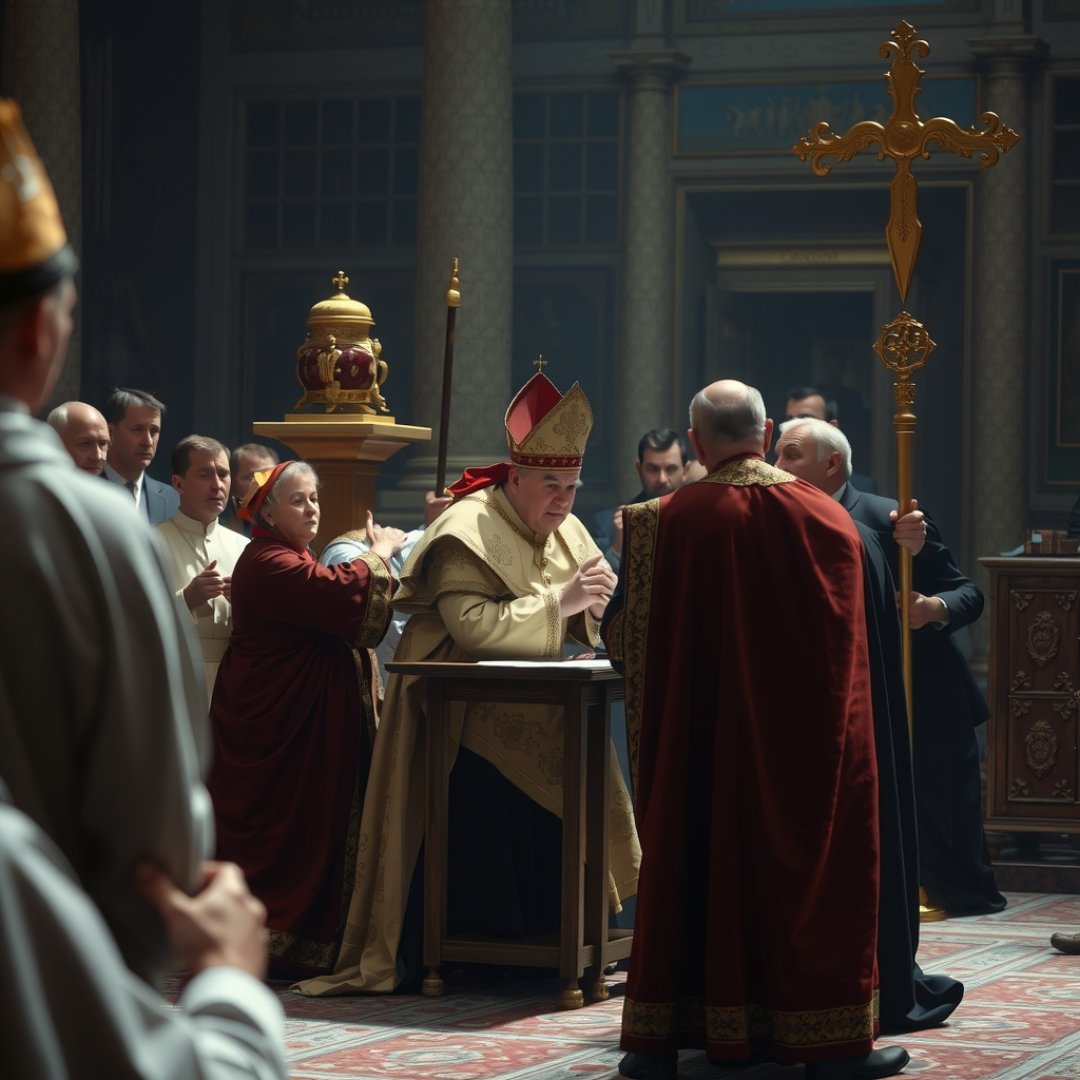
The mid-10th century in Rome was a tumultuous period, marked by the intertwining and often clashing ambitions of spiritual and temporal rulers. Central to this drama was the infamous Pope John XII, a figure whose scandalous lifestyle and political machinations led to one of the most significant power struggles of the early medieval era. The deposition of Pope John XII by Emperor Otto I in 963 AD represents a pivotal moment, not merely a punitive act against a corrupt pontiff, but a profound declaration of imperial authority over the very seat of St. Peter. This event set a precedent for future interactions between the Holy Roman Emperors and the Papacy, laying bare the deeply contested nature of supremacy in Western Christendom and foreshadowing centuries of conflicts over investiture and temporal control in the heart of Rome. It reflected the broader chaos of the Saeculum Obscurum, where local Roman nobility, the Papacy, and emerging imperial powers fought for dominance.
Pope John XII’s Tumultuous Reign and Alliance with Otto I
Born Octavian of Tusculum, Pope John XII ascended to the pontificate in 955 AD at a remarkably young age, succeeding his father, Alberic II, as the temporal ruler of Rome and thereby merging the spiritual and secular leadership of the city in an unprecedented manner. His papacy quickly became notorious for its extreme secularism, lavish banquets, and moral transgressions, drawing widespread criticism and scandal. Contemporary sources, though often biased, depict him engaged in hunting, gambling, and even outright sacrilege within the Lateran Palace. However, John XII was also a shrewd politician.
Faced with threats from Berengar II of Italy, he sought aid from Otto I, the powerful King of Germany. In 962 AD, John XII crowned Otto I as the first Holy Roman Emperor in Rome, initiating a renewed imperial presence in Italy. This alliance was solidified by the Privilegium Ottonianum, which recognized papal temporal authority over certain territories while also asserting the emperor’s right to confirm papal elections. The ink was barely dry on this agreement, however, before John XII, wary of Otto’s growing power in Italy, began to conspire against his new patron, seeking alliances with Berengar II and even the pagan Magyars. This blatant betrayal ignited Otto’s fury and set the stage for a dramatic confrontation.
Imperial Justice: Otto I’s Return to Rome and the Synod of 963
Upon learning of John XII’s duplicity, Emperor Otto I swiftly marched his army back to Rome in late 963 AD. He was met by an assembly of bishops, cardinals, and Roman nobility who, weary of John’s tyrannical and immoral rule, eagerly supported imperial intervention. Otto I convened a synod in St. Peter’s Basilica, effectively transforming it into a court to try the reigning pontiff. John XII, however, refused to appear, allegedly fearing for his life or perhaps simply defying the imperial summons.
During the synod, numerous accusations were leveled against John XII. Witnesses testified to grave offenses, including:
- Sacrilege and blasphemy.
- Simony, the selling of ecclesiastical offices.
- Perjury and incest.
- Murder and mutilation.
- Converting the Lateran Palace into a brothel.
Despite the severity of the charges, John XII remained defiant, even excommunicating Otto I and the synod members from afar. Unswayed by this, the synod, with Otto’s strong backing, proceeded to formally depose John XII, marking a profound assertion of imperial power over the Papacy. The assembled clergy then elected a layman, Leo, a respected papal protonotary, as Pope Leo VIII, bypassing traditional canonical procedures.
The Deposition’s Aftermath and Lasting Impact
The deposition of Pope John XII did not immediately resolve the crisis. While Otto I was in Rome, Leo VIII was widely accepted, but as soon as the emperor departed, John XII returned with his loyal Roman factions. He violently drove out Leo VIII, punished his supporters with mutilations, and reinstated himself on the papal throne. His restored papacy, however, was short-lived. In May 964 AD, John XII died, reportedly from apoplexy while in the act of adultery, though other accounts suggest he was murdered by an enraged husband.
Following John XII’s death, the Roman populace, still resisting imperial imposition, elected Benedict V as pope. Otto I again returned to Rome, besieged the city, and forced the Romans to surrender Benedict V, who was then formally deposed and sent into exile. Leo VIII was once more installed as the legitimate pontiff. This tumultuous period underscored the deep-seated tension between the spiritual authority of the pope and the temporal power of the emperor, a conflict that would define much of medieval European history. The events of 963-964 AD established a precedent for imperial intervention in papal elections and deposals, leading to centuries of struggle for control over the Roman Church and the broader political landscape of Italy.
Frequently Asked Questions
Who was Pope John XII, and why was his papacy controversial?
Pope John XII, originally Octavian of Tusculum, became pontiff at a young age in 955 AD. His papacy was controversial due to widespread accusations of moral misconduct, including sacrilege, promiscuity, and turning the Lateran Palace into a scandalous hub, alongside his active political maneuvering.
What prompted Emperor Otto I to intervene in Rome and depose Pope John XII?
Otto I intervened because John XII, after crowning Otto as Holy Roman Emperor and establishing an alliance, betrayed him by secretly conspiring with Otto’s enemies, including Berengar II of Italy. This political double-dealing infuriated the emperor.
What exactly happened during the Synod of 963 AD?
Emperor Otto I convened a synod in St. Peter’s Basilica in 963 AD, where numerous accusations of moral and political offenses were brought against Pope John XII. Despite John’s refusal to appear, the synod, backed by Otto’s authority, formally deposed him and elected Leo VIII as the new pope.
Did John XII accept his deposition, or did he attempt to regain power?
John XII absolutely did not accept his deposition. After Otto I left Rome, John XII returned with his supporters, violently drove out Leo VIII, and reinstated himself as pope, demonstrating the fierce resistance to imperial interference.
What was the long-term significance of the deposition of Pope John XII for imperial-papal relations?
The deposition of Pope John XII by Otto I established a significant precedent for imperial intervention in papal affairs, highlighting the ongoing struggle for supremacy between the Holy Roman Emperor and the Papacy. It fueled centuries of conflicts over papal elections, investiture, and temporal control in Italy and the broader European political landscape.
Related posts:
 The Cadaver Synod of 897 AD: Rome’s Posthumous Trial of Pope Formosus
 Otto I’s First Italian Campaign and the Iron Crown (951 AD)
 The Coronation of Otto III and Election of Pope Gregory V (996 AD): Reshaping Roman and Imperial Power
 The Roman Senate’s Petition to Pope Clement VI (1343): A Plea for Papal Return