
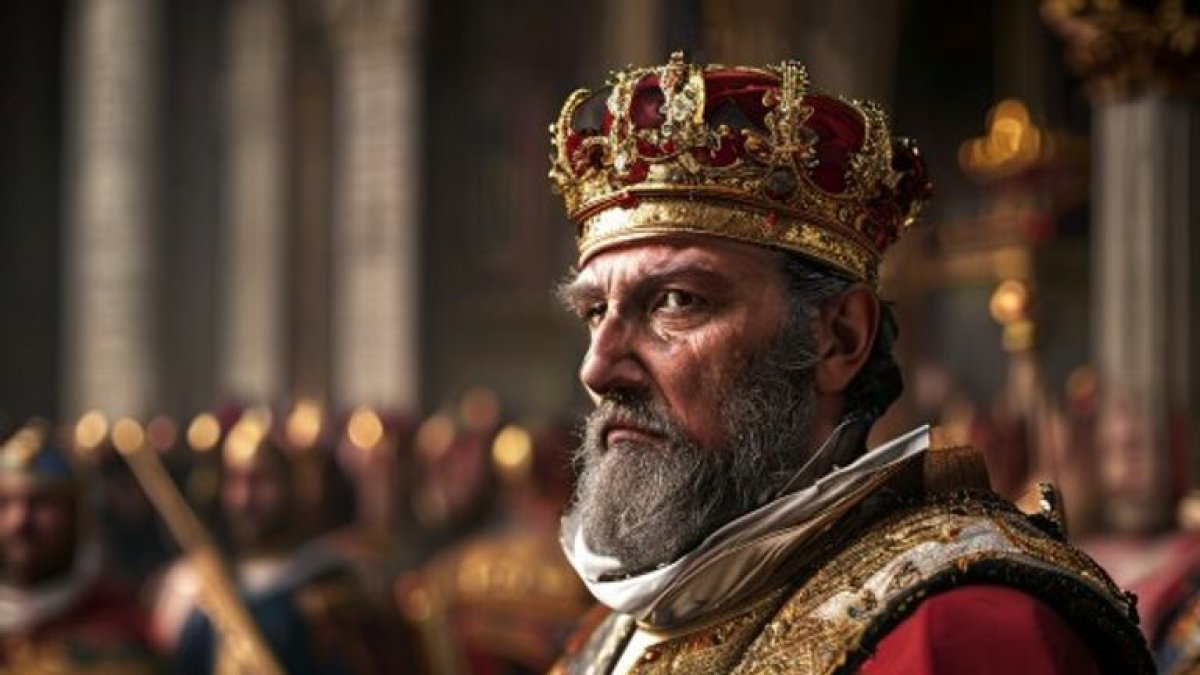
The year 817 AD marked a critical juncture for the vast Carolingian Empire, a realm that, though far removed from the classical Roman Empire, consciously sought to inherit and perpetuate its imperial legacy. Louis the Pious, son and successor of Charlemagne, faced the formidable challenge of governing a dominion that stretched across much of Western Europe. His ambition was to ensure the continuity of the imperial title and the unity of his sprawling kingdom, a goal that culminated in the promulgation of the Ordinatio Imperii 817. This significant decree was more than just a succession plan; it was a deeply considered attempt to institutionalize the imperial ideal, striving to prevent the fragmentation that often plagued early medieval monarchies. Louis, guided by ecclesiastical advisors like Benedict of Aniane, envisioned an empire united under a single emperor, even as he made provisions for his younger sons to govern subordinate kingdoms. This act, therefore, represented a pivotal moment in the evolution of early medieval political thought and the enduring, albeit transformed, concept of a pan-European Roman Empire.
The Carolingian Legacy and Louis’s Dilemma
Following the death of his formidable father, Charlemagne, in 814 AD, Louis the Pious inherited an empire of unprecedented scale and complexity in Western Europe. Charlemagne’s reign had seen the revival of the imperial title, harking back to Roman glories, and the establishment of a vast, if loosely governed, domain. However, the Frankish tradition of dividing patrimony among all male heirs stood in stark contrast to the Roman concept of an indivisible empire. Louis, a deeply religious man, felt a strong moral imperative to preserve the unity of the Christian empire, viewing it as a divine trust. He recognized the inherent dangers of fraternal conflict and fragmentation, which had historically weakened kingdoms. His dilemma was how to reconcile Frankish custom with the newly re-established imperial ideal, ensuring both stability and the spiritual integrity of his realm. This pressing concern led him to seek a definitive legal framework for succession that would, he hoped, avert future disputes.
Blueprint for Imperial Succession
The Ordinatio Imperii 817, or ‘Order of the Empire,’ was promulgated at Aachen and meticulously laid out Louis’s vision for the empire’s future. Its central tenet was the indivisibility of the imperial title, designating his eldest son, Lothair, as co-emperor and sole heir to the imperial dignity upon Louis’s death. Lothair was to rule over the core of the empire, ensuring its continuity and overarching unity. However, the decree also made provisions for his younger sons:
- Pippin was granted Aquitaine, Gascony, and parts of Burgundy.
- Louis the German received Bavaria and surrounding territories.
These younger sons were to govern their respective kingdoms as subordinate kings, swearing fealty to Lothair and unable to wage war or make foreign policy without his consent. The intent was clear: while territories might be administered locally, the imperial superstructure, symbolized by the single emperor, would remain intact, preventing a complete dissolution into independent realms. The document also emphasized the spiritual unity of the empire, reflecting Louis’s deep piety and the influence of his clerical advisors.
Seeds of Discontent and Future Fragmentation
Despite Louis the Pious’s earnest intentions, the Ordinatio Imperii 817 ultimately failed to achieve its primary goal of perpetual imperial unity. Almost immediately, seeds of discontent began to sprout. Louis’s nephew, Bernard, King of Italy (who was excluded from the Ordinatio’s provisions as he was Charlemagne’s grandson, not Louis’s son), rebelled, feeling his rights infringed upon. Bernard’s swift defeat and blinding, which led to his death, cast a dark shadow over the emperor’s reign and demonstrated the inherent fragility of the decree.
Later Challenges and Divisions
Moreover, the subsequent birth of Louis’s fourth son, Charles (the Bald), in 823 AD, necessitated revisions to the Ordinatio, further upsetting the delicate balance and sparking renewed conflicts among his sons. Louis’s attempts to repartition the empire to provide for Charles led to a series of devastating civil wars that plagued the latter part of his reign. Upon his death in 840 AD, the empire descended into open warfare, culminating in the Treaty of Verdun in 843 AD, which irrevocably divided the Carolingian Empire into three distinct kingdoms, effectively nullifying the unity envisioned by the Ordinatio Imperii. While the document’s immediate practical impact was limited by subsequent events, it remains a crucial testament to the enduring concept of a unified Roman imperium in the early medieval West, a political ideal that continued to inspire and shape European history for centuries.
Frequently Asked Questions
What was the main purpose of the Ordinatio Imperii 817?
The primary purpose of the Ordinatio Imperii 817 was to preserve the unity of the Carolingian Empire under a single emperor, Louis the Pious’s eldest son Lothair, while also providing subordinate kingdoms for his younger sons, Pippin and Louis the German.
Who were Louis the Pious’s sons and what roles did they receive?
Louis the Pious’s eldest son, Lothair, was designated co-emperor and future sole emperor. His younger sons, Pippin, received Aquitaine and parts of Burgundy, and Louis the German was granted Bavaria and surrounding territories, both as subordinate kings.
Did the Ordinatio Imperii successfully preserve the Carolingian Empire’s unity?
No, the Ordinatio Imperii ultimately failed to preserve the empire’s unity. Subsequent political events, including the birth of Louis’s fourth son Charles and ensuing civil wars among his sons, led to the empire’s formal division by the Treaty of Verdun in 843 AD.
Why is the Ordinatio Imperii considered significant in medieval history?
Despite its practical failure, the Ordinatio Imperii is significant because it represents a pioneering attempt to establish a legal framework for imperial succession that prioritized unity over traditional Frankish patrimonial division. It reflects the enduring influence of the Roman imperial ideal in the early medieval period and shaped subsequent political thought on empire.
Related posts:
 The Treaty of Brétigny (1360): A Fragile Peace in the Hundred Years’ War
 Claudius and the Praetorian Coup: The Unexpected Emperor, 41 AD
 The Battle of Vouillé of 507 AD: Clovis I and the Rise of Frankish Dominance in Gaul
 Carloman’s Abdication and Monastic Retreat (747 AD): A Pivotal Shift in Frankish Power