
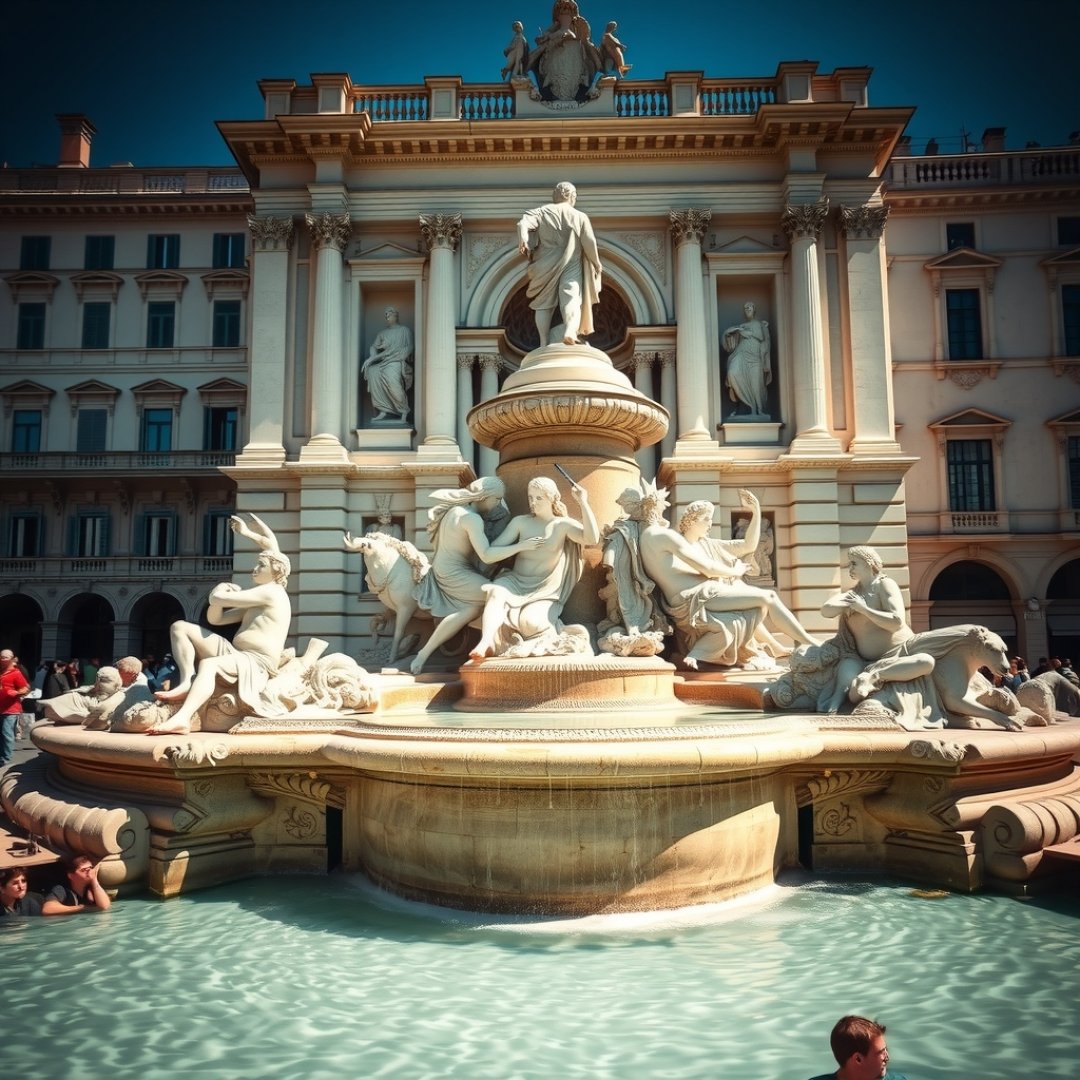
In the vibrant heart of 17th-century Rome, a monumental artistic vision took shape, forever transforming one of the city’s most ancient public spaces. The creation of the iconic Fountain of Four Rivers (Fontana dei Quattro Fiumi) between 1648 and 1651 stands as a testament to the unparalleled genius of Gian Lorenzo Bernini, the undisputed master of Baroque art, and the ambitious patronage of Pope Innocent X. This grand aquatic sculpture, dominating Piazza Navona, was more than just a decorative element; it was a powerful statement of papal authority and Rome’s enduring claim as the center of a divinely ordered world. Bernini’s ability to seamlessly blend architecture, sculpture, and the natural element of water into a dynamic, theatrical whole cemented his legacy and dramatically influenced the aesthetic of the Eternal City during the High Baroque era. The fountain remains a captivating focal point, drawing millions to admire its intricate details and colossal scale, a true jewel in Rome’s rich historical crown.
The Genesis of a Grand Papal Commission
The commission for the Fountain of Four Rivers arose from Pope Innocent X’s ambitious plan to beautify Piazza Navona, a space that was not only a grand public square but also home to his family palace, the Palazzo Pamphili. The Pope initiated a competition in 1647 to design a fountain to stand before the Pamphili palace, intending to reuse an ancient Egyptian obelisk, previously part of the Circus of Maxentius, as its centerpiece. Although initially excluded from the competition due to rivalries with the Barberini family, Bernini famously submitted a model to the Pope through a clever maneuver, bypassing official channels. The exquisite silver model, showcasing his revolutionary design, so impressed Innocent X that he reputedly exclaimed, “The only way not to employ Bernini is not to see his works!” This dramatic turn of events secured the prestigious commission for Bernini, demonstrating the power of artistic brilliance to overcome political obstacles.
Symbolism and the Colossal Centerpiece
At the heart of Bernini’s design for the Fountain of Four Rivers is the ancient Roman obelisk, a symbolic nod to Rome’s imperial past and its continuity through the Papacy. Surrounding this central element, four colossal marble figures represent the world’s four great rivers, signifying the global reach of papal power and the Catholic Church:
- The Nile: Represented by a veiled head, symbolizing its then-unknown source.
- The Ganges: Depicted with an oar, signifying its navigability.
- The Danube: Gazing towards the Pamphili family church of Sant’Agnese in Agone, representing Europe and Catholicism’s heartland.
- The Río de la Plata: Shown with coins, symbolizing the riches of the Americas.
Each river god is accompanied by specific flora and fauna native to its region, adding layers of intricate detail and naturalism. The entire composition is surmounted by the Pamphili dove with an olive branch, the family crest of Pope Innocent X, further asserting his patronage and divine favor.
Bernini’s Artistic Vision and Engineering Mastery
The Fountain of Four Rivers is a quintessential example of Baroque art, characterized by its dynamism, drama, and emotional intensity. Bernini’s masterstroke was to animate the static stone with the fluid movement of water. He engineered the fountain so that water gushes and tumbles over rugged travertine rockwork, creating a naturalistic grotto that serves as the base for the towering obelisk and the colossal river gods. This innovative use of natural elements and the interplay between light and shadow brought the entire composition to life. The figures are not merely decorative but interact with their environment and each other, turning the fountain into a theatrical spectacle. Furthermore, the engineering required to bring sufficient water pressure to create such a magnificent display, sourcing it from the Acqua Vergine aqueduct, was a significant achievement for its time, highlighting Bernini’s skill not only as an artist but also as a practical engineer.
Piazza Navona: A Baroque Stage for Rome
The completion of the Fountain of Four Rivers fundamentally redefined Piazza Navona. What was once an ancient stadium (the Stadium of Domitian) and then a bustling market square, transformed into one of the most magnificent urban spaces in Baroque Rome. Bernini’s fountain became the magnetic focal point, drawing the eye and guiding movement within the elongated piazza. His work complemented the surrounding architecture, including Francesco Borromini’s church of Sant’Agnese in Agone, creating a harmonious yet competitive dialogue between the two great Baroque masters. The fountain’s central placement and impressive scale established a new standard for urban design, where art and architecture collaborated to create immersive and awe-inspiring public experiences. Even today, the fountain acts as a grand stage, anchoring the piazza’s vibrant atmosphere and serving as a timeless symbol of Roman artistic ingenuity.
Frequently Asked Questions
What do the four statues on the Fountain of Four Rivers represent?
The four colossal statues represent the four great rivers of the world known at the time: the Nile (Africa), the Ganges (Asia), the Danube (Europe), and the Río de la Plata (Americas), symbolizing the global reach of papal authority.
Who commissioned the Fountain of Four Rivers?
The Fountain of Four Rivers was commissioned by Pope Innocent X from Gian Lorenzo Bernini, primarily to adorn Piazza Navona in front of his family palace, the Palazzo Pamphili.
Where is the Fountain of Four Rivers located?
The fountain is prominently situated in the center of Piazza Navona in Rome, Italy, one of the city’s most famous and historic public squares.
What is unique about the design of the Fountain of Four Rivers?
Its uniqueness lies in Bernini’s integration of an ancient Egyptian obelisk as its central element, surrounded by dynamic, expressive sculptures and naturalistic rockwork from which water dramatically gushes, creating a living, theatrical monument.
When was the Fountain of Four Rivers completed?
The construction of the Fountain of Four Rivers took place between 1648 and 1651.
Related posts:
 The Domus Aurea: Nero’s Golden Palace and Its Controversial Legacy
 The Construction of Hadrian’s Wall (122-128 AD): Rome’s Northern Frontier
 Caligula’s Baiae Pontoon Bridge (AD 39): An Emperor’s Eccentric Spectacle
 The Early Construction of the Trevi Fountain in 1734: Pope Clement XII’s Grand Vision